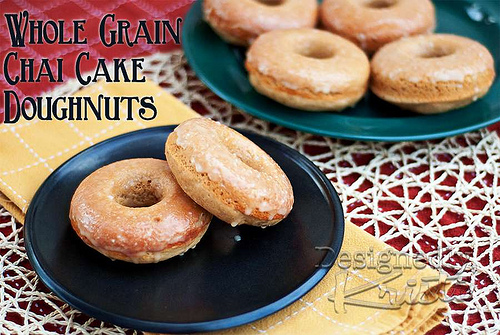
One of the treats I’ve missed most in my two year adventure in healthier eating has been doughnuts. I’m a huge cake doughnut fan, especially of the chocolate with chocolate icing or glazed pumpkin or applesauce varieties. But dang, the calories on those are crazy. I’d have to run for nearly an hour to burn them off!
I kept seeing baked doughnuts on Pinterest and finally caved this summer and bought a doughnut pan for baking cake doughnuts at home. The first few recipes I tried from various blogs were less than satisfying. The results were rather shallow little doughnuts. The flavors were good, but the format left me still craving a doughnut. Then I decided I wanted some recipes that had been hopefully tested so I bought Lara Ferroni’s Doughnuts: Simple and Delicious Recipes to Make At Home. Success at last! I really just needed to fill the doughnut pan more and reduce the servings per recipe to get a satisfying doughnut.
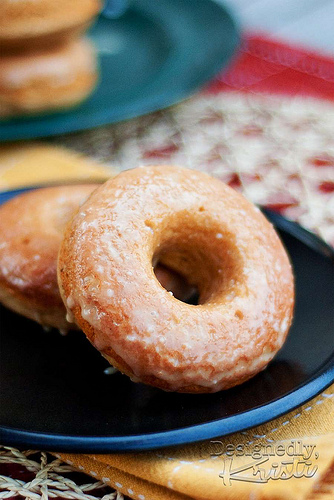
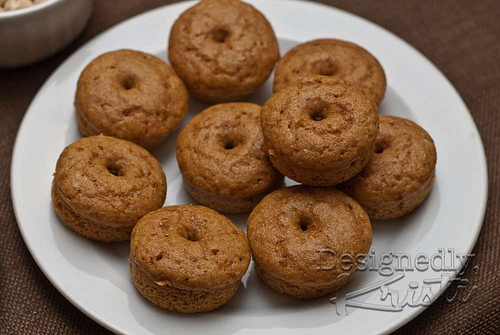
Most of the baked recipes are certainly an improvement over the fried bakery variety in terms of calories and fat grams, but that was pretty much the only improvement in nutrition. They still had refined flour and sugar, things I’m trying to reduce as much as possible. So, I started tweaking the basic baked doughnut recipe of Ferroni’s to include more whole grains. The result? These Whole Grain Chai Baked Doughnuts that have on the order of 150 calories less than your standard bakery-bought variety and nearly 4g of fiber per doughnut so they will stick with you and reduce spikes in your blood sugar levels.
You start out the base doughnut recipe by scalding milk. This changes the chemistry slightly and can really aid in maintaining tenderness in baked goods. It is a common step in my most of the Swedish baked goods I make. For chai doughnuts though you add black tea to the scalded milk and let it steep for 5 minutes. It really makes the difference between chai doughnuts and say a spiced or snickerdoodle doughnut. You can use any black tea, but I used the darjeeling that I use when I make my chai concentrate.
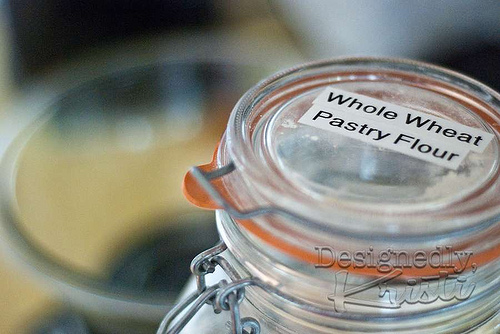
Lara’s original recipe does call for some whole wheat pastry flour so it was not a complete departure. But I decided to add more of it, and sub the remainder of the AP flour with white whole wheat flour. If you haven’t heard of white whole wheat flour you’ve been missing out! It is naturally white, made from a different type of wheat (softer, spring wheat if I’m remembering correctly). It is *not* white because the bran has been stripped off. The bran is intact. The different protein make up of this type of wheat makes it much closer to AP flour in how it behaves and I find has an even milder flavor than traditional whole wheat flour. I frequently sub it 1:1 for AP in recipes with great results. That said, whole wheat flour, even white, can have a strong flavor, especially if you are new to increasing your whole wheat consumption. This makes these doughnuts a great place to start. The tannins in the black tea and the strong spices of chai all work together to mask the whole wheat flavor.
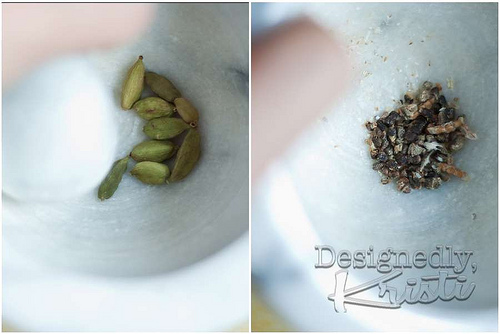
Speaking of spices, do yourself a favor and buy your cardamom (an essential spice in Indian cuisine and chai especially) in pods. The flavor is astronomically different than even unground, but shelled cardamom. It takes a little extra time, but is totally worth it. It actually grinds quite easily in a mortar and pestle, though you could use a spice dedicated coffee grinder too. I’d also encourage freshly ground nutmeg in this mix. If using pre-ground of either nutmeg or cardamom I’d be really tempted to nearly double the amounts so they hold up against the stronger flavors of cinnamon and ginger.
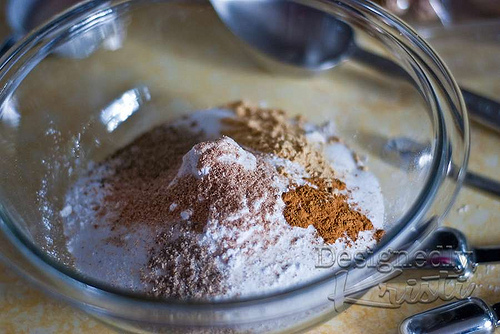
I’m often a tad lazy and don’t bother with the sifter, opting instead to just whisk all the dry ingredients together. But don’t do that here! Sifting works a good amount of air into the ingredients that actually remains in the final product and helps it develop a really nice crumb. It also serves to catch the little bits of cardamom that didn’t get ground quite fine enough.
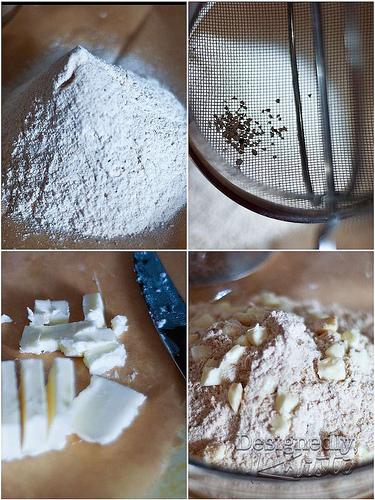
Once all the dry ingredients are mixed, I add in the butter. The goal of this step is to coat most of the flour in fat which will impede gluten formation once we add the wet ingredients. This again helps with the crumb, keeping the donut light and cakey rather than chewy and bread-like. I find it easiest to accomplish this by cutting the butter into tiny, tiny cubes - like 1/4″ tiny. Then with just my fingers work it all into the dry ingredients until it is a consistent texture that will hold a shape if squeezed, but easily break back apart. It should seem a lot like a boxed cake mix.
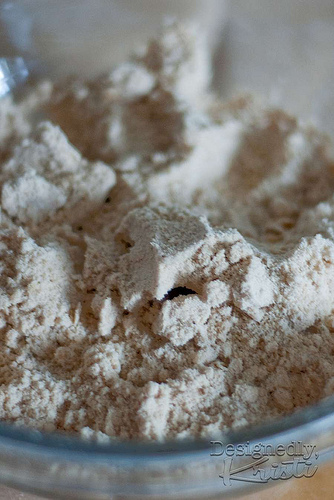
Once the butter is all incorporated, I add the remaining wet ingredients to the cooled milk tea (also known as a cambric) - greek yoghurt, egg and vanilla extract and whisk it together well.
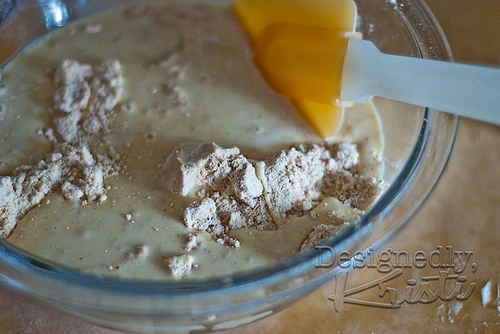
Add the wet ingredients to the dry and fold it together until everything is incorporated and then stop. The less you mix it the loftier and airier your final doughnuts will be. Since they won’t be shocked with hot oil this has proven to be one of the keys to a successful baked doughnut in my experience.
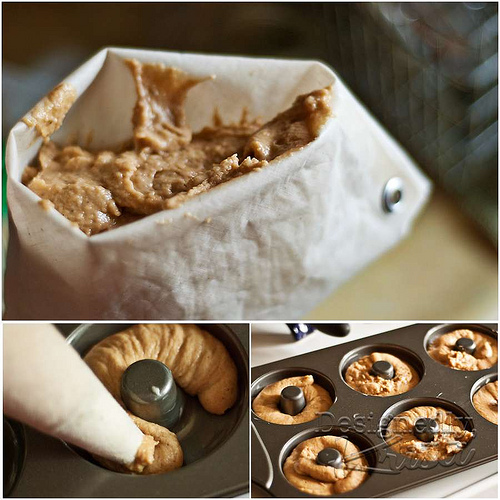
Now, transfer the batter to a piping bag with a large tip attached. If you don’t have a piping bag you can also put it in a plastic bag and snip the corner off. I find the doughnuts look more authentic when piped into the greased doughnut pan rather then spooning them. Plus it is less messy in my experience with no drips on the pan and what not.
I’ve run across some recipes that call for the wells to be filled less than 1/2 way but those resulted in rather flat doughnuts. They tasted good, but they never satisfied a doughnut craving. I fill mine about 3/4 full for a more normal-looking doughnut. It does result in more calories, but if I don’t end up stopping at the bakery for a more satisfying doughnut the next day, I’m ahead! And it is still significantly fewer calories than a bakery doughnut. You could probably get away with 2/3 or 1/2 full and get 8-10 donuts rather than my 6 if you really want. I definitely wouldn’t recommend stretching the batter any farther than that. I like the 6 because I only have to go through one baking cycle and I’m done and I’m lazy that way. There are also always the mini donut pans if you want a smaller portion size. I have one on my wish list so I can make small donuts for SnB.
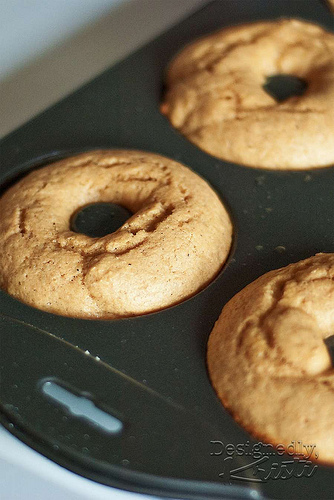
Another trick I’ve found for baked cake doughnuts is to pull them from the oven when they still look a little underbaked. They may have darkened just a titch, but while in the oven you likely won’t say they’ve turned color. You need to leave them in the pan for 5 minutes or so and they’ll continue to carryover cook for that time. The baking time really is less than ten minutes in the oven, even with that much batter! Don’t second guess it, you’ll be sorry, we were for a few batches when I first started baking doughnuts.
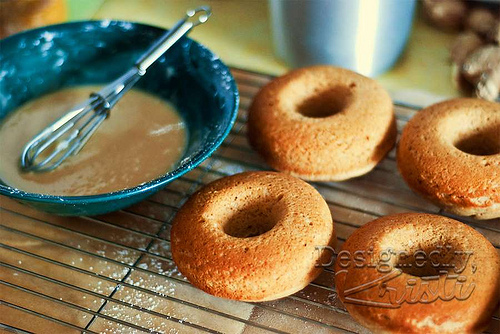
I start mixing the glaze as soon as I pop the pan into the oven. This glaze is your standard milk and powdered sugar glaze, though you use some of the milk tea that was leftover and I add just a tiny bit of cream cheese or butter if I have it on hand because I find just a hint of fat help curbs the cornstarch-y flavor of powdered sugar. Since I’ve dirtied the sifter already I do go ahead and sift the powdered sugar for a smoother glaze. Once the doughnuts have come out of the pan and are just a bit warmer than room temp you can dunk them in the glaze. I always put the parchment paper I use while sifting underneath the cooling rack so any drips land on that for easy clean-up.
One thing of note about glazed doughnuts – you need to eat them pretty quickly. Without the fat from frying, the glaze tends to soak right into the doughnut after sitting for a few hours. If you won’t be eating all six in a couple of hours I’d either glaze as needed or opt to do a cinnamon-sugar coating by spraying the doughnuts with an oil mister or cooking spray and dipping in the cinnamon-sugar.
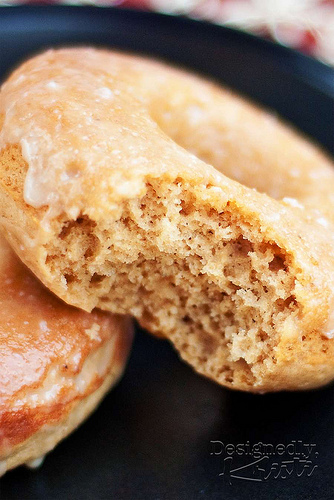
Whole Wheat Baked Chai Doughnuts
Serves 6, Adapted from Doughtnuts: Simple and Delicious Recipes to Make at Home
Ingredients
Batter:
- 1/2 cup 1% fat milk, scalded
- 2 tablespoons black tea
- 2 tablespoons (1 ounce) unsalted butter, chilled throughly
- 3/4 cup (90 grams) white whole wheat flour
- 2/3 cup (60 grams) whole wheat pastry flour
- 1 teaspoon baking powder
- 1/2 teaspoon cinnamon, ground
- 1/2 teaspoon ginger, ground
- 1/2 teaspoon cardamom, ground
- 1/4 teaspoon nutmeg, ground
- 1/2 teaspoon salt
- 1/3 cup (75 grams) sugar*
- 1/4 cup plain yogurt
- 1 teaspoon vanilla extract
- 1 egg, beaten
Glaze:
- 1 1/2 cups (150 gm) powdered sugar, sifted to remove lumps
- 3-4 tablespoons tea infused milk
- 2 teaspoons vanilla extract
Directions
- Preheat the oven to 350 degrees F. Lightly grease doughnut pan and set aside.
- Cut butter into many small pieces and place in the freezer to chill thoroughly.
- In a small saucepan, scald the milk. Add tea leaves and steep for 5 minutes. Strain out the tea leaves and set aside to cool.
- Sift together the flours, baking powder, spices and salt. Make 3 passes through the sifter for maximum air incorporation. Place in a large bowl and whisk in the sugar.
- Using your fingers, work butter into the flour mixture until thoroughly incorporated; there should be no discernible bits of butter. The mixture should clump together when squeezed but break apart easily.
- In a small bowl, mix together 1/4 cup of the tea infused milk with the yoghurt, extract and egg. Reserve the remaining infused milk for the glaze.
- Add the wet ingredients to the dry and mix gently until just combined. Over mixing will cause chewy doughnuts.
- Put batter into a piping bag fitted with a large tip and pipe into doughnut pan, filling each cavity 3/4 full. Make sure the center post stays clear of batter.
- Bake for 6-10 minutes, just until set and the doughnuts have taken on a slight golden blush. Let cool in pan for 5 minutes, then move doughnuts to a cooling rack.
- While the doughnuts bake, mix together the glaze ingredients, adding a bit of milk at a time until you reach the proper consistency.
- Once the doughnuts have cooled, dip in glaze and place on the cooling rack to set.
Nutrition Info (1 doughnut, without glaze): 208 calories; 5.5 g fat; 2.9 g sat; 31.9 g carbohydrate; 3.5 g fiber; 12.5 g sugar; 5.9 g protein.
* I used turbinado sugar, though the original recipe calls for superfine. Next time I make them I think I’ll try coconut (no, it doesn’t taste like coconut) palm sugar or date sugar.
If you require gluten free goodies, Lara Ferroni’s book has basic recipes for gluten free doughtnuts to which you can easily add the required spices to make it a chai variety. I highly recommend the cookbook as there are basic recipes for cake and raised doughtnuts, each baked and fried, and gluten free varieties as well. All the special flavors and what not are just changes to those basic recipes so you can choose the base recipe that works for you. The same thing applies to the glazes, frostings and other coating options. Once you read through the variations it is even easy to come up with your own doughnuts and finishing touches.