Fiber Fool

Follow the feats and foibles of a fiber fanatic.

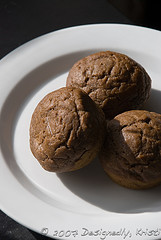
CAUTION! Food Ahead: Pumpkin Molasses Muffins

Filed under: In the Kitchen — Kristi at 6:08 am on Wednesday, November 7, 2007

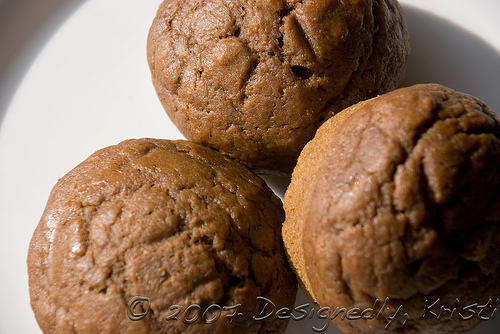
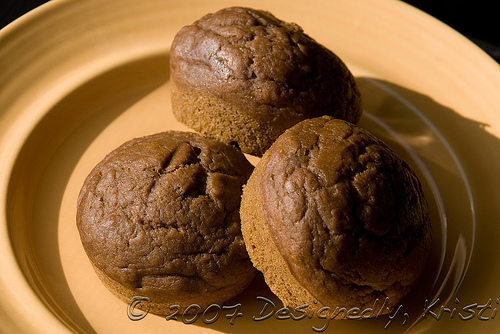
Pumpkin Molasses Muffins on a Yellow Plate

I’ve been playing around with a molasses muffin recipe, adding fine chopped apples from our tree, mixing up the spices and such. The original formula is quite good while the muffins are still warm but they quickly became a bit dry for my taste. The apple version was an improvement, but because the apples were diced, they didn’t lend as much moisture to the muffins as I had hoped. I’d certainly make it that way again if I had apples around, but I think apple sauce might be a better option.

Last weekend I made a really yummy pumpkin dip (sans dried beef) to take to the Halloween party. I upscaled it slightly to use two full packages of cream cheese, but it left me with about 3/4 of a cup of pumpkin remaining from the can I opened and it was needing to be used. Jackpot! Necessity really is the mother of invention. The Pumpkin Molasses Muffins were born. The pumpkin was just what the muffins needed for the missing moisture. With only two of us in the house it takes a few days for us to get through a dozen muffins so it is fantastic to have that extra moisture so that they are still yummy for a few days after baking. Plus, pumpkin puree is a great way to sneak in some extra fiber and vitamins.

Kristi’s Pumpkin Molasses Muffins

Pumpkin Molasses Muffins

  • 1 1/4 C Flour
  • 1/4 C Sugar
  • 1/2 t Baking Soda (plus an extra pinch for high altitude)
  • 1 t Ground Cinnamon (heaping)
  • 1 t Ground Ginger
  • 1/2 t Fresh Ground Nutmeg (double if pre-ground)
  • 1/4 t Salt
  • 1 Lg Egg
  • 1/2 C Water
  • 1/4 C Vegetable Oil
  • 1/4 C Molasses
  • 3/4 C Pumpkin Puree (not pumpkin pie filling)

Preheat oven to 325 degrees F. In a large bowl, beat egg and add remaining wet ingredients. Beat well, until lighter and more voluminous. In a medium bowl mix dry ingredients. Fold the dry ingredients into the wet ingredients about a third at a time and mix just until fully moist. Be careful not to overmix of the muffins will be tough and chewy.

Grease or line a muffin pan, and fill 2/3 full. Bake at 325 degrees F for 20-25 minutes (or 12-16 minutes for mini muffins) or until done. Cool for 5 minutes then remove from pan and cool on a cooling rack. Store in an airtight container for up to three days. Makes 1 dozen standard muffins or 2 dozen mini muffins.

Pumpkin Molasses Muffins 2

Note: I think some of the oil could be cut back on since pumpkin can be used to substitute for fat content like apple sauce and I will be trying that next time. If you wish to up the fiber content more try substituting part of the flour with whole wheat (usually up to 1/3 can be whole wheat without a noticeable change in flavor or texture). For a special occasion and extra special treat, top each muffin with a mix of chopped pecans, butter and brown sugar.

More Sock Yarn Reviews!

Filed under: Knitting, Socks, Socktoberfest 2007 — Kristi at 10:50 am on Tuesday, November 6, 2007

Last week I got to raid Amanda’s sock drawer and take photos of her hand knit socks that still reside in her household. I took photos (sans lightbox, which I found was a mistake, but I was lazy and didn’t want to drag it over to her house) and she kindly wrote up a review of the yarns she has used. Due to some photo troubles a few of the sock yarns have been left out. For that I apologize.

In case you missed it, my reviews from this year can be found in the Oct 31st post, and last year’s reviews can be found here. Now, onto Amanda’s assessment of several sock yarns…

I’ve probably knit 30 pairs of socks by now, including those that have been gifted. I don’t believe in handwashing my socks and treating them delicately - they are on my feet all day after all. So, I generally opt for superwash fibers that I then throw in the washing machine (usually on cold or cold/warm) and will even put them in the dryer a bit on low temp to help speed the drying process before hanging them or laying them flat to dry (depending on where I have space). Here I’m sharing the wear of socks that live in our house and are subjected to these conditions. They’ve been knit over the course of several years. I prefer a tighter gauge so that I can’t feel the stitches on the soles of my feet. My husband on the other hand, doesn’t tend to have as tender a foot so I opt to knit his socks at a looser gauge to get them done faster. However, you can see this has had an impact on the longevity of some of his socks. Comparing our socks is a bit apples to oranges though considering he wears handknit socks nearly EVERYDAY and I actually will wear commercial socks which means mine aren’t on quite the same frequent rotation as his are.

We wear our socks in everyday shoes so I choose to knit fingering weight. The heaviest socks I’ve knit are the Socks That Rock medium weight which is a heavy finger weight to light dk/sport weight. For a sweater gauge I would probably use a US 3 although I knit these socks on a US 2.

Silja

8.5 sts/inch
Although not widely available I’ve found this yarn to be a great option if you’re looking for a wide range of solid colors. Check out
the selection at TheKnitter.com. Overall I’m very happy with the wear on these socks (some piling but this is what I would consider normal) and would use this yarn again although I wouldn’t say it was a favorite yarn to work with. It didn’t have a magnificent hand, but at the same time it didn’t have any drawbacks.

Brown Sheep Wildfoote Luxury Sock Yarn

Color SY-100 Rock ‘n Roll
75% Washable wool, 25% Nylon
7 sts/inch
This is another yarn that is available in several solids, barber pole styles (bi- and tri-color twists), and variegateds. Unfortunately, this yarn can be a bit splitty and notice that although the two socks are from two skeins that are the same color and dyelot they do not truly match. I started the socks on Swallow casein needles and found that the combination caused some headaches as the yarn stuck to the needles too much. The socks have worn well, some felting has occurred on the heels (where I used reinforcement thread as well) but nothing major.

Blue Moon Fiber Arts Socks That Rock Mediumweight

Mist
100% Superwash Merino
Pattern: Weekend Knitting, Petticoat Socks by Veronik Avery
7 sts/inch
This yarn of fairly recent fame grabbed my attention when The Fold sold out of nearly 800 skeins in the first few hours they were open at The Maryland Sheep and Wool Festival a couple years ago. Sadly, my socks are already showing considerable wear after only a few wearings/washings (this is the youngest pair of the bunch here). Of course this is due in part to my care for them. On the inside of the ball band it does say: “Superwash yarn is machine washable. However, we recommend for a longer life turn inside out and handwash in warm water with mild detergent.”

I have not followed this suggestion. However, I’ve found most of the wear to coincide to my Dansko Mary Jane style clogs. Where the strap rubs against the foot I have a furry abraded bit, in addition to the allover halo the sock has developed. So, sure you can blame the shoe, however, I wear these same shoes with all my handknit socks and so far this is the only pair of socks to show this anomaly. Still the yarn is a joy to work with and I have and will continue to use it for nonsock knitting. Currently, on the needles are a few baby hats and they look great. I can get three of these hats out of one skein.

Lang Jawoll & Lang Jawoll Color

75% New Wool, 18% Nylon, 7% acrylic
830198 (green) 8.5 sts/inch
820089 (multi-color) 8 sts/inch
The green socks were knit in 2002 and were in heavy rotation when I first completed them. They sort of got forgotten when the sweater they matched perfectly (from J. Crew) shrank a little in the wash. They are worn inside out for a smoother fabric against the foot. No noticeable halo on these socks and only slight felting on my pressure points. The yarn shows great stitch definition and as a bonus comes with a spool of matching reinforcement thread in the center of the skein.

The multi-color ones sadly have not held up as well as my green pair. I think this is due mostly to the gauge difference. This yarn certainly benefits from a tighter gauge. But, this pair has also been worn far more than mine. I will be darning the balls of the feet before they are worn again.

Fortissima Colori Sock Color


Color 2412
75% Virgin wool, 25% Polyamide
8 sts/inch
What a fun yarn to work with - very much like Trekking. This yarn had a great soft hand. There has been some haloing, but again I feel this is due more to the gauge than the yarn itself and with as much regular wear as it is put through I think that the amount of age the sock shows is perfectly appropriate.

Lana Grossa Meilenweit

80% New Wool, 20% Polyamid
Meilenweit Fantasy Color 4710 (Rainbow) 8.5 sts/inch
(purple/mustard/brown/orange stripes) 8.5 sts/inch
Meilenweit Multiringel Color 5090 (Pinks/Yellow stripes) 10 sts/inch
Meilenweit Fantasy Color 4760 (Green/Blue/Orange) 9.5 sts/inch
Not only is this a reliable yarn I might even venture to say it’s my favorite, or tied for first place. I’ve knit it in several gauges and
found that it lasts regardless. The colors are bright and have lasted. There has been no haloing or piling to speak of. A few of the most heavily worn pairs have shown slight felting in the high wear areas, but nothing major. I’m still impressed with the lack of haloing and piling.

Regia

75% New Wool, 25% Polyamide
Regia Line Steps Color 5363 (Cream) 8.5 sts/inch (see here)
Regia Jacquard 5294 (Pastel) 8.5 sts/inch (see here)
(blues/greens) 8 sts/inch
(Blue w/ color bursts) 7.5 sts/inch
This is a reliable yarn. Every pair of socks I’ve knit from them (I can think of 8 off the top of my head) have worn well. The newer ones show little haloing, but nothing more. The ones shown here are the first pair of socks I knit for my now husband (Valentine’s 2002). Since they were his only handknit pair of socks for nearly a wear they have seen more washings than I can count. At least two wears per week for a few winters. Now, they aren’t as pretty due to some slight felting and piling. But, they haven’t lost any of their color. In fact, they still match the left over yarn - which is great since I need to darn the balls of the feet before their next wear.

The photo at the top of the post was my first pair of socks I ever knit. They’ve had lots of wear, and are probably my favorite. Even though the heel is knit in St St rather than a “heel” stitch of some sort it still looks good. Sure there is some slight felting, but it’s very minor and there is no halo to speak of, even at this relatively loose gauge.
On Procrastination and Commitment

Filed under: Knitting, Apparel, Ethnic Knitting, Designing — Kristi at 9:28 am on Monday, November 5, 2007

Designing a sweater for yourself can be a nerve-wracking undertaking. Yes, I have Donna Druchunas’ hand holding via Ethnic Knitting Discovery (EKD), along with many other experienced and talented authors of books such as Knitting in the Old Way (KITOW), The Knitter’s Handy Book of Sweater Patterns (KHBSP), and Designing Knitwear, I even have the ear and inbox of some other experienced and talented knitters who knit with me weekly such as Amanda, Ashley, and Deb (in alphabetical order so as to not offend). Yet I’ve had the yarn for probably nearly a month now and I hadn’t cast on.

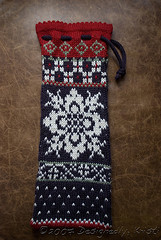
Swatch Bag Post-BlockingYes, I did have for a while a more pressing deadline project, though it required different physical and mental muscles than my Norwegian Boatneck project which could have been a welcome break from the other tasks. Yet, I never turned to this project for my break knitting. Yes, it will require more attention than socks. Yes, it required some calculations and re-planning due to the huge difference in row gauge from what I expected and what I actually got. But, really with only an hour or so of effort the sweater would be ready to get started on (if I hadn’t switched spreadsheet software anyway). In fact, since I plan to knit the sleeves first to double check my gauge with my oversized swatch, I could have cast on with less calculations and re-planning. Yet, I didn’t.

I had decided last week that I would cast on and get started on Monday. As of Thursday afternoon I still hadn’t committed to the final measurements of the sweater and thus hadn’t refined the original design or cast-on. Instead, I’ve logged most of my stashed handspun on Ravelry. I’ve caught up on my Ravelry groups. I’ve caught up on my blog reading (mostly). I’ve spun more yarn for a project I want to knit, but didn’t really have time to spin for or knit right now. I’ve checked and rechecked sizing for similarly constructed sweaters in magazines, on-line, and in books. I’ve measured all of my non-ribbed sweaters in my closet, none of which are constructed in the same manner as my Norwegian Boatneck will be, so it doesn’t help me that much to know their measurements.

I do have some decisions made. It will be a modified drop shoulder, boatneck sweater with picot hems at the cuff and body bottom. The colors have been chosen (duh, if the yarn has been here for a month). I am going to put some shaping in because the mid-section will just be lice, which accommodates shaping just fine and plus-sized bods that have shaping should have plus-sized clothes that have some shaping, even if that isn’t traditional for that type of sweater. I also know that the bust measurement is going to be slightly less than the hip measurement.

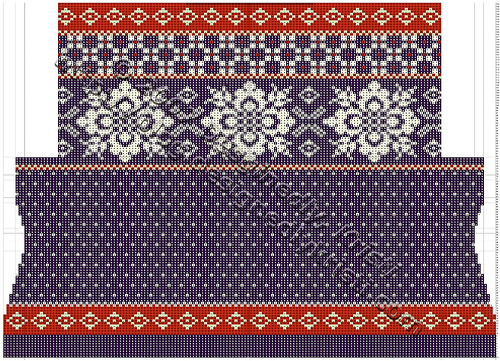
Final Diagram of Norwegian Boatneck Sweater

I still had decisions that needed to be made though. What should the hip measurement be? In an informal poll at SnB I found that despite my larger size than everyone else, a few others have roughly the same bust/hip differences that I do and to my knowledge they don’t normally knit a larger sized bottom to their sweaters. Though the initial reaction to my measurements was to put more ease into the hip area of the sweater than into the bust area. Yet, very few of my store bought tops (sweaters and tees alike) have larger bottoms than the chest, even those that are shaped. The tops that I do have that were cut bottom heavy I dislike the fit of. I think they look like maternity tops when I wear them. The only exception is a CJ Banks sweater that has a few extra ribs at the bottom; but it is a ribbed sweater so it just skims your natural curves. I was actually surprised to note that they bothered to shape the sweater. That is often a rarity in moderately priced store bought knits in my experience. So I’m reluctant to even match my chest ease at the hips. That would make for an obviously tent shaped A-line garment. Plus, books like Righetti advocate negative ease at the hip to avoid sweater growth. Though I suspect that is a better practice when using ribbing than a picot hem.

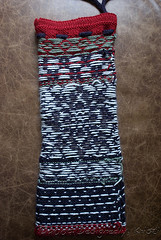
Inside of Swatch BagOf course if I am going to start with the sleeves, why hadn’t I cast-on and pondered these issues while working the sleeves? Well, because I of course couldn’t decide on the proper sleeve circumference either. I think I’ve settled on the wrist circumference. But what about the top circumference and arm hole depth? I was measured at 11 inches. Following the various books I’ve consulted it should be 12.5-13 inches deep. Measuring my sweaters I get 9.5-10 inches, though none are of a drop or modified drop construction, though their measures correspond pretty closely to those in KHBSP for their given construction methods. I obviously don’t want the sleeves so tight that it restricts movement and that is why drop and modified drop shoulder sweaters require a greater armhole depth. But, as a plus-sized woman with a decent chest, I don’t need a bunch of extra fabric bunched up around my arm pits either - not to mention that wouldn’t mesh with the silhouette if I’m giving it a bit of shaping. It has also been my experience that frequently once clothing gets up to the chest circumference in my neck of the woods the proportions and dimensions start to match up with a man’s body more than a woman’s. At this point I think I’ve decided to go with the 11 inch depth because I’m so short waisted the 12.75” armhole depth would have the sleeve coming straight out of my waist. Not to mention, even with a larger cuff than I normally care for, the increase rate of the sleeve was crazy. With the 11” depth and thus 22” sleeve circumference at the top the increase rate is a bit better.

nanoswemo.jpgAt this point I was questioning and likely over thinking too much and it fed my procrastination. I needed something to pull me out of this spiral. Enter NaKnitSweMo (on Ravelery)! Corresponding with DH’s participation in NaNoWriMo, it is perfect. It also gives me a deadline (which I am moving up slightly so this sweater is done, washed, blocked, and dried in time to take it with me to MN when I leave on the 29th - I’m aiming for the 25th I think). I am allowing myself to continue to spin in this time period and I can continue on the socks I started while we were on vacation, but they are only to be knit on to give my hands a break from the bigger needles or when I am still on the sleeves and knitting in public. I am not allowed to seek out knitting in public as an excuse to avoid the sweater and the only reason I can knit the sock when working on the sleeves is that sleeves will require 8 balls of yarn attached, which I don’t consider very portable. In reality now that the sleeves have hit the lice section I think it’ll be portable enough for SnB tonight. Though given that I’m just starting the lice on the sleeves today I am having my doubts that this will be done before I leave for MN.

Wish me luck!

Finally, The Handspun!

Filed under: Spinning, Finished Objects — Kristi at 3:45 am on Thursday, November 1, 2007

It has been completed for nearly ten days now. Well, completed in terms of mechanical input, but it still required skeining and washing when we left for our mini vacation. But, it is done now and I’m in love!

My first truly fingering weight yarn - at least I think so. I’m really excited to get this swatched and see what kind of gauge works well with it. I’ve been fooled before because my handspun tends to be much debser than many commercial yarns. The sheen is gorgeous, I think the color changes are going to look nice in the final fabric, and the yarn still has some elasticity to it despite the hard spinning and the 40% bamboo content. The color is not as masculine as I hoped, but more so than I feared. It is still higher contrast than I have hoped for when I asked for a shaded solid. I think Drew would gladly wear it, but many men wouldn’t - though those men only like boring black/gray/brown socks. So I’m undecided on what sort of design I’m going to knit with it - male? female? unisex? Fortunately I volunteered to be bumped so the deadline for this has eased by a few months, giving me plenty of time to swatch and really do the yarn justice.

Close Look at Atomic 6 3-Ply HandspunFiber: Blue Moon Fiber Arts, 60/40 Merino/Bamboo, Atomic 6
Weight: 6.7 oz
Drafting Method: Short Forward aka “Inchworm” (Worsted)
Wheel: Majacraft Suzie Pro
Ratio Singles/Plying: 15:1 (both)
Yardage: 650-700 yds
Ply: Traditional 3-ply
WPI/Yarn Classification: ~17 WPI/Fingering
TPI: ~7 TPI

This was a very pivotal yarn. It was my first real yardage of 3-ply at my preferred sock gauge. It was my first skein over 4 ounces. It was my first time spinning to a deadline (which got lifted, but I made it anyway). It was my first time spinning BMFA fiber and I have to say it was a real pleasure. It is remarkably consistent despite some worries I had at various points in the process. The spinning of the skein forced me to fix some ergonomic issues that had gone unnoticed previously (and yes, I swear I’ll cover that soon). I learned a better plying set-up for me when plying in the basement. I used my highest ratio from start to finish and still felt at times that I was “running” on the wheel (note to self: look into the higher speed whorl option). I got to try the Majacraft skeiner and overall it worked okay, though I was pushing the capacity, even though my bobbin wasn’t quite full. I *love* this yarn and definitely feel it is my best to date. Now, where are my needles?

Actually, now that the real FO deadline has been lifted some other projects require my attention first. Unfortunately…

1. Atomic 6 Handspun, 2. Atomic 6 Handspun, 3. Atomic 6 Handspun, 4. Atomic 6 Handspun

« Previous Page