Fiber Fool

Follow the feats and foibles of a fiber fanatic.

Linkity Love

Filed under: Linkity — Kristi at 12:55 pm on Monday, February 6, 2012

My Week In Summary

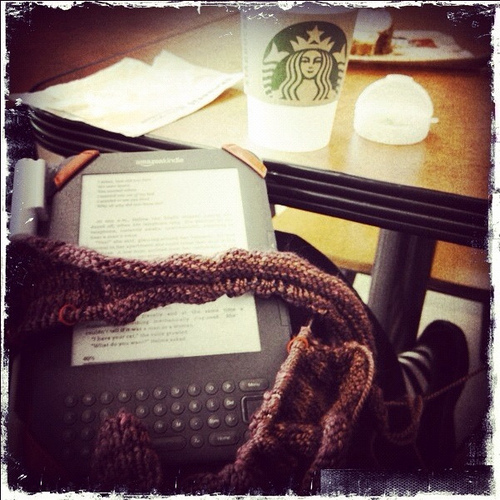
This photo pretty much sums up my week. Knitting, knitting, reading, coffee, more coffee, more knitting, more knitting. That was early in the week I’ve more than doubled the fabric on the needles now. But I think I need to step it up because not only is this knitting due Feb 21, but another project whose yarn still hasn’t arrived as of Friday (I haven’t checked the mail since due to snow/ice conditions in front of the community mailbox). Fortunately, charts and most of the write up for that one are more or less complete so it is just the knitting that needs done on that one.

Crafty:

Yummy:

Pixely:

  • For those doing a 365/366 Photo a Day Project, I suspect you are starting to run into days where finding something to phtoograph is getting tough. This post has some great ideas, as well as some strategy to keep you from running around during your bedtime routine frantically trying to take a photograph.
  • If you are a fan of the effects from Hipstamatic or Instagram but have some photos not taken on your phone that you’d like treated in the same manner, here is one way to use Photoshop to create a Lomography effect.
  • This post shows you some ways to create magical photos - in camera!

Naturally:

  • HildaBlue has a Body Butter Recipe to Die For that I cannot wait to try once I’m out from under deadlines!
  • I find powdered dry shampoos messy to deal with, but here is a spray version, I’ve seen it suggested to use witch hazel in place of the alcohol for a more scalp-friendly formulation
  • Making my own perfume is something I really want to try. I’ve kind of dabbled in creating blends in body oils and my lotion bars, but I haven’t found something I love enough to concentrate more into a perfume, hopefully this series will shed some light on my experiements!
  • Crunchy Betty is my new fav natural/diy body care blog. Last week she shared a great project for Valentine’s Day - Moisturizing Bath Candy!

For more, check out Stumbling Over Chaos. You can also connect with me on Pinterest to get the links as I stumble upon them instead of waiting for Mondays.
Slipper KAL: Construction Overview & Heel Flap

Filed under: Knitting, Knitting Patterns, Slipper KAL — Kristi at 6:06 pm on Sunday, February 5, 2012

Annotated Masala Construction

I think one of the biggest stumbling blocks in knitting either the Masala or Pemberley slippers is to let go and trust the pattern. The slippers definitely look like socks and parts of their anatomy are the same as socks. Even some of construction is like socks. But they aren’t socks so there are some definite things that are done differently when knitting these slippers.

Because of the lines of the colorwork on Masala I think it is easier to see the construction on those, but Pemberley is worked in the same fashion. Instead of 3 stitches of ribbing at the edges around the foot you have the lace edging. There are differences in numbers due to the differences in gauges, but the basic construction is identical.

Construction is started at the heel tab. If you’ve ever done a picot or a hemmed edge, that is how the heel tab is formed. It is just worked over a small number of stitches. If you are not familiar with this technique check out this video on YouTube which gives a good overview. It is lacking the turning row that I like to use for a nice crisp “crease” but the basics are the same.

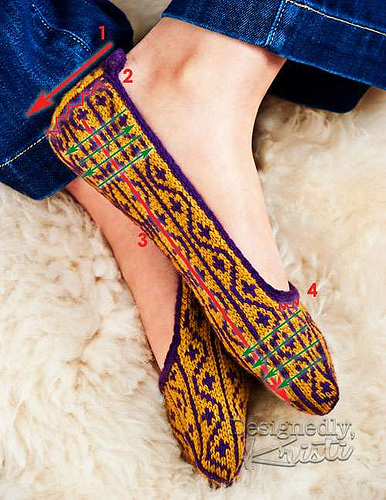
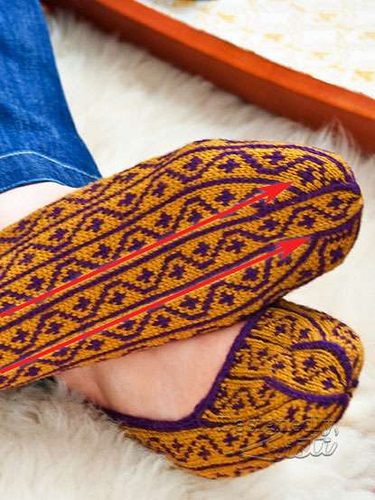
Once the heel tab has been completed you continue working a narrow heel flap (1 in the photo above). It is worked flat, knitting back and forth in stockinette stitch. Unlike sock heel flaps, do not slip the first stitch of each row. Stitches will be picked up a little differently. Because the heel flap here is so narrow there is no need to “turn the heel” like you would in a sock with a heel flap. This heel flap is already the width of the live stitches at the end of a turned heel flap heel. So the cup of the heel is just formed by picking up and knitting stitches along both edges of the heel flap (2 in the photo above). If you look at the bottom of Masala in the photo below, the strip between the two red arrows are the original heel flap stitches worked the entire length of the slipper!

More Masala Construction Annotation

Now one of the other tricky bits is this picking up of heel stitches. I’ll go into it in more detail in the next post. But because we are turning such tight corners around that narrow heel flap it works best to use a DPN for each of the sides even though ultimately you will continue to work the knitting flat (indicated by the green arrows alternating directions) and not in the round. A circular needle just can’t make those tight corners. Once you have 1.5-2″ of fabric after the heel flap you can switch to a circular and I recommend doing so. The knitting goes a bit faster and you don’t have to worry about ladders where the needles meet. You’ll continue working the sides/sole of the slippers flat (3 in the top photo) until you get to the ball of the foot or so. The exact length will depend upon your total foot length as well as the vamp depth you desire.

To keep finishing to a minimum, you’ll pause work on the main part of the slipper and extend the edging (ribbing in the case of Masala and lace in the case of Pemberley) on one side of the slipper for the length required to go across the top of the foot and connect the two sides. Then stitches are again picked up along that edging and then knitting in the round begins. You’ll work in the round evenly for a bit and then you’ll start decreasing for form the toe and you are done except to weave in ends! That’s it!

Next post I’ll show you how to pick up and knit the stitches along the heel flap. As I mentioned above we’ll be doing so a little differently than on socks. Any questions so far?

Slipper KAL: Yarn

Filed under: Knitting, Knitting Patterns, Slipper KAL — Kristi at 5:21 am on Wednesday, February 1, 2012

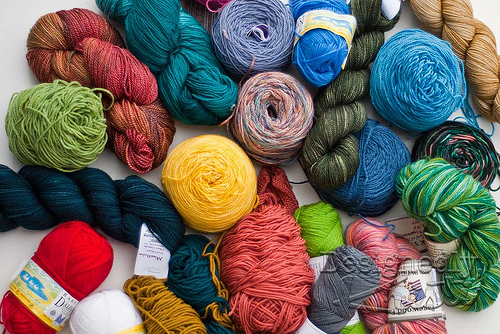
Stash Diving for the Tale of 2 Slippers KAL

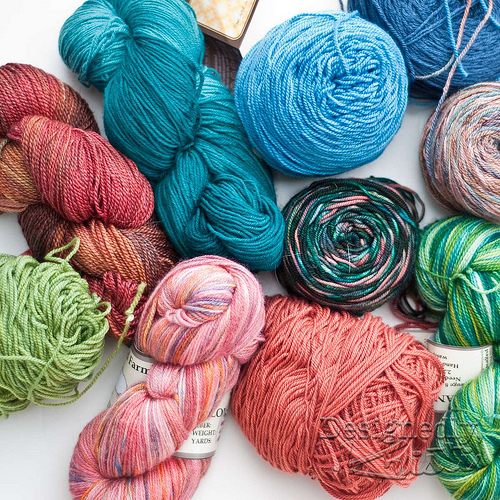
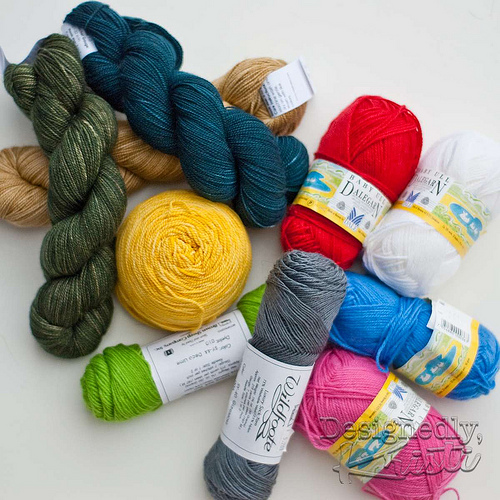
I went stash diving. Above are the yarns I felt may work for either Masala or Pemberley. In general, I opted for solid or semi-solid colors as those will show off the lace or colorwork better than high contrast handpaints - though a couple of the more subdued ones snuck in. If you have a keen eye you may note the left overs from the original slippers in the pile. I have enough of those to do a sample slipper during the KAL, but I’m thinking I probably want to knit the samples in something different. Partially so I at least have the option of a full pair and so we can find out what other yarns work well for the patterns.

Aside from color, what was I looking for? Well, both Masala and Pemberley’s called for yarns are categorized as sport weight, but the yarns are not interchangeable across the patterns - something that is clear if you have both patterns. The gauges and overall numbers are quite different. Masala calls for 10 sts/in and Pemberley calls for 8 sts/in.

I know it is confusing that they both call for sportweight but such drastically different gauges. This is because the two yarns are drastically different in their construction. The Louet Gems Sport is a merino yarn. Merino is usually spun in a style called worsted spinning (this is different than the weight of yarn) which aligns all the fibers in parallel before spinning and the spinning is done in a dense fashion to keep all the ends firm in the yarn to reduce pilling and to give greater durability to such a fine and soft yarn. All that density means it does not compact much when knit on smaller needles than called for.

Now, Chickadee from Quince & Co is spun from non-merino wool. Because the wool is not as fine and soft as merino it is spun with more air in the yarn, which is ultimately warmer as the air in the yarn acts are insulation. This air can then be compressed out as you knit it on needles smaller than called for. That is why it easily (without any hand strain) knit up at 10 sts/in. The non-merino wool is a bit hardier and you get more yardage by weight. If you want to knit Pemberley with a non-merino yarn I suspect Quince & Co’s Finch fingering weight yarn would work well, though I haven’t worked with it yet.

Now, without swatching, how do you know if a yarn will work or not? You can test this a bit in the store by taking a 6″ section of yarn and putting more twist into it and seeing if that reduces the diameter of the yarn significantly. If you can take it down to a light fingering diameter the yarn will work for Masala. If you can’t compress it much by adding twist the yarn is a better fit for Pemberley. If you are shopping online, look at the grist - the yardage per weight. Chickadee is 181 yds / 50 g of yarn. Louet Gems Sport is 225 yds / 100 g, or so you compare apples to apples 112.5 yds / 50 g! There is a big difference, hence the big difference in gauges despite the same yarn weight classification. Now, difference in types of fiber will make a difference. Alpaca is much lighter than wool and cottons and most plant fibers are heavier than wool, so grist isn’t enough to let you skip the swatching!

So, what yarns did I choose?

Stash Diving for the Tale of 2 Slippers KAL

For Pemberley:

Stash Diving for the Tale of 2 Slippers KAL

For Masala:

So, which yarn or yarns have you chosen for which pattern? Have you swatched and gotten gauge with it yet? If you haven’t don’t worry as long as you are okay with ripping out the heel flap it can serve as a mini-swatch. Though with it’s narrowness there is a possibility you may go farther and find out you need to rip. For the least hassle - swatch!

I’ll have an overview of the construction and we’ll knit the heel flap next time!

« Previous Page