Exploring Knitting Techniques
My mom always said that as soon as I learned everything I needed to know about something I pack it in and move on. Looking back, I think there is some truth in what she said. Perhaps what has kept me knitting and taking photos for much longer than most of my other hobbies is that there is *always* something new to learn with these topics. My design portfolio can best be described by the fact that I touch upon many different types of techniques and approaches to construction such that there is often something new to learn in any of my patterns - toe-up socks, top-down socks, circular knitting on DPNs, top-down hats, an unusual way to avoid holes in thumb gussets, cables, lace, traveling stitches, stranded colorwork, intarsia, non-traditional constructions and on and on.
Those of you who know me in real life or have been lurking here on the blog for a length of time likely know I am one of many scientists turned knitting designer. It seemed only natural to combine my scientific nature with my enjoyment of exploring new techniques and create a series of technique-based classes.
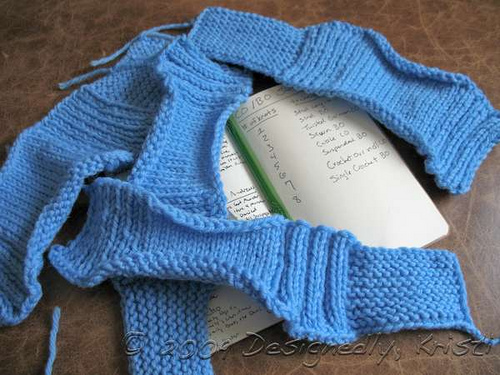
Starting this week (and likely to be repeated in the later summer and/or fall) I am starting a series of classes at My Sister Knits called Knit Voyagers. Each class is a stand alone 2-hour class. You can take 1 or all 4 that are currently in the series. This week we’ll be embarking on the exploration of cast-ons. In preparation for these classes the past few weeks I’ve had my head buried in all the classic knitting reference books. I’ve been knitting swatch after swatch after swatch so there are many examples to fondle and stretch and pull on so we can observe the elasticity, durability and overall aesthetic of each cast-on. Each swatch when appropriate contains 1×1 ribbing, 2×2 ribbing, garter stitch and stockinette stitch. While the swatching at times can seem tedious, the ability to compare cast-ons side by side and make notes about their various properties makes my scientific side sing!
If you are interested in embarking on such an exploration but can’t do so with me, I have a few tips. Firstly, the single knitting reference book I’ve found with the most cast-on and bind-off techniques is Montse Stanley’s Knitter’s Handbook : A Comprehensive Guide to the Principles and Techniques of Handknitting . It is fantastic. I do struggle a bit with the illustrations, but that is normal for me. She covers a large number of cast-ons - some with many variations. There are even a couple pages categorizing which cast-ons are appropriate for certain knitting situations. Even if you’ve been knitting for years, there is valuable information in these pages!
My second tip involves keeping track of the swatches. You’ll notice there are no tags present on the swatches in the photo. That is because they are all unblocked as of the taking of the photograph. Yes, blocking can sometimes seem tedious, but one cannot accurately judge the properties of a cast-on (or bind-off) without properly finishing it. But, tags are not waterproof. How do you keep track of what technique was used on each swatch? Wash each one separately? No way! See the notebook tucked under there? That is my key. In the tail from the CO I tied a certain number of knots. The same with the BO tail. Each time, I tied one more knot. The notebook is a record of how many knots in each tail mark which CO or BO! Then once the swatches are dry I can put my tags on so I don’t have to dig up my notebook with the key each time I want to reference my swatches when starting a project. I have now gotten up to a ridiculous number of knots to tie so I’m going to tie in place a small hair elastic (they are cheap and easily replaced) to represent my tens.
If you are curious what other topics we’ll explore in Knit Voyagers the first session is Cast-Ons, the second is Bind-Offs which will be next week. In June we’ll look at Directional and Paired Increases and Decreases which are important when working fitted garment or raglans. That will be followed by Center-Out Cast-Ons (think Turkish, Figure-8, Emily Ocker etc.). By the end of this initial series someone taking all four should have much knowledge in making sure their handknits are the best they can be.