Contest: Blocking Sawtooth Edgings?
Yesterday morning I bound off the last stitch on a design that has been about 6 weeks in the making. It has been a fantastic journey and one I hope to repeat in the future. It involved many swatches, two of which I blocked like the finished object (in two different weights of yarn). Now it is time to block the final object and I don’t know how to do it.
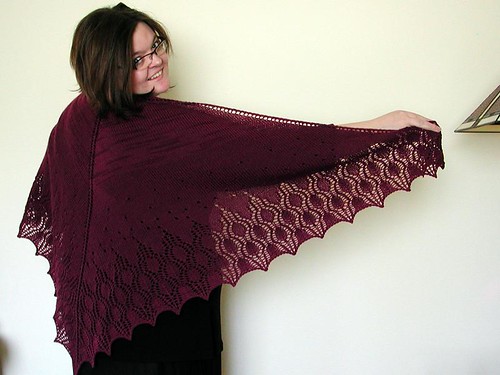
I do only have one pointed edge shawl I’ve knit, Seraphim by Miriam Felton (shown above) and I did so in a sport weight yarn (Brown Sheep’s NatureSpun Sport). It was not nearly as pointy a design as this or knit sideways to the body either so I had just pinned out each tip individually.
I’m not quite happy with the blocking job on either of the swatches for this project. Now it is time to block the final project and I’m uncertain about how to proceed. Let me show you extreme close-ups that don’t give away too many details, as I probably shouldn’t be talking about this project…
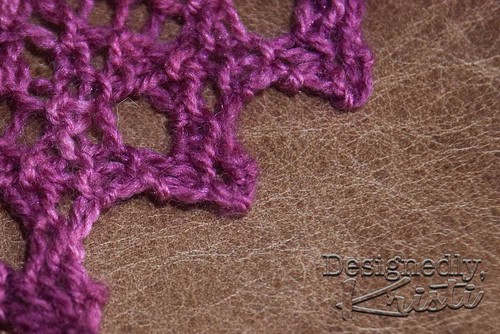
For the first swatch I used wires to block the main portion, then I used T-pins to individually block each point of this sawtooth edge. The swatch was only about a quarter of the size of the final project and I ran out of T-pins about three-quarters of the way through those. In addition to my needing to purchase at a minimum two more boxes of T-pins, it takes a long time to block each of those out. If I could have shown you a wider angle you would also see more clearly that the points were not equally blocked and I’m pretty sure I could have fussed with pin placement on the swatch for the entirety of a day and still found ones that required slight adjustment.
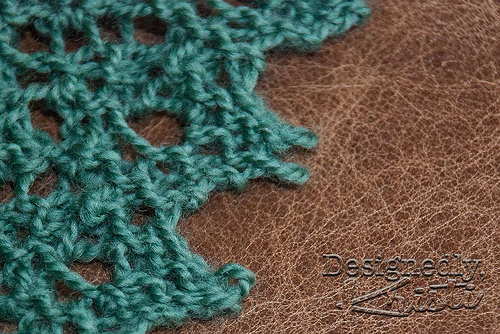
So, when it came time to block the fingering weight swatch I decided to try a different tactic - run my blocking wires through each point on a side and pin the center 1-3 repeats individually as needed. That way they are all pulled the same distance from the body and blocked probably as equally as is humanly possible. Absolutely a fantastic idea in principal. In practice, not so great a fit with a knitted on edging whose stitches run perpendicular to those on the body. I found I had to run the wires through two stitches for each point. If I only caught a single stitch it just drastically distorted that stitch and did not effectively block the edging. I continued on merrily thinking it was going to be great. It looked good while it was lying on the bed drying. Wrong! Notice how each point is actually two rather distinct loops? Not quite the effect I’m going for here.
Up to this point I’ve used welding rods for blocking wires. They are great for straight lines because they don’t bend and bow as easily so if you aren’t doing extreme blocking they only need pinned down at the ends. When I stopped in at MSK today I picked up their last in stock blocking wire kit. These blocking wires are probably nearly half the diameter of my welding rods. What is your experience? Will I lessen (or hope of hopes eliminate) the two-loop points with a smaller circumference blocking wire?
How would you go about blocking something with an almost saw-tooth edge like this? Keeping in mind that there are well over 100 points to be blocked in the full-size finished object?
Why don’t I turn this into a contest! Give me a suggestion and your name will go in a drawing for a free electronic copy of the pattern once it can be released to the general public. I’ll draw one more name from that pool for every 25 suggestions I get on this post. Because I’m under a deadline and need to get this blocked and photographed soon, comments will close on Friday, August 6th at 11:59pm MDT.
Would you like more chances to win?
- Share the contest on your blog and trackback or leave a comment with a link to the post in a comment (trackbacks and comments for extra entries do not count towards the 25 suggestions increments).
- Follow me on Twitter and post a tweet about the contest. Be sure to include @fiberfool in your contest tweet so it gets counted and please tweet only once per day!
- Like Designedly, Kristi on Facebook and share the contest on there. Leave a comment here with a link to your Facebook post.
I can’t wait to hear your suggestions!