Fiber Fool

Follow the feats and foibles of a fiber fanatic.

FO: Three of Diamonds
Filed under: Knitting, Photography, Socks, Finished Objects, Knitting Patterns, Designing — Kristi at 9:49 am on Monday, February 23, 2009

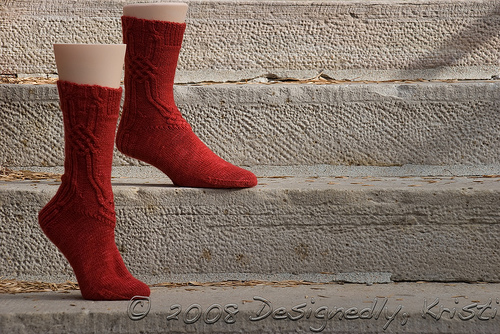
Three of Diamonds on Steps

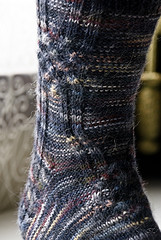
Early this fall I did a sock design for TheKnitter.com’s Luxury sock club for their November shipment. I enjoyed the design so much and had such a time photographing (took over 350 shots and purchased additional photography equipment) that I decided to knit myself a pair in easier to photograph yarn. Now the pattern is available to everyone!
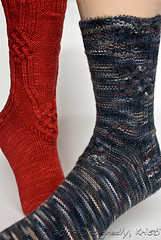
DSC_8994wtmk.jpgPattern: Three of Diamonds (on Ravelry)
Designer: Myself
Needles: 2.75 mm & 2.5 mm
Yarn: Misti Alpaca’s Handpainted Sock Yarn in Shadow (dark) and Miss Babs Yummy Sock and Baby 2-Ply Fingering in Sandi’s Red Monochrome
Size: Wmn’s US9.5 (red) and Men’s US10.5 (dark)
For: Myself (red) and DH (dark)

While this pattern was one of my most challenging to grade into multiple sizes (and there are 5 adult sizes), it is a fun and relatively easy knit for those comfortable with cabling. There is a lot of stockinette or reverse stockinette to balance out the time it takes to knit the cables. I knit each sock only took one weekend of dedicated couch potatoeness. The five sizes were crucial and worth some of the hair pulling since the ribs and cables make this a great sock choice for men and I know how difficult it is to find man friendly patterns that are interesting to knit and don’t take 4 years to finish in such larger sizes. So the sizes of the pattern range from a finished sock foot circumference of 7-10 inches. With more sizes to choose from there can be leeway in gauge and still find a stitch count that produces the adult size sock you need.
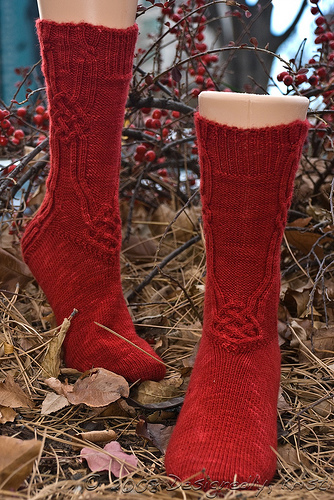
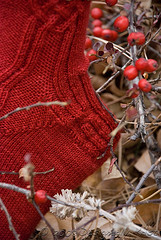
Three of Diamonds with Berries

My favorite part of these socks is how the cuff ribs flow right into the diamond cables on the leg, then the ribs that exit that diamond split and half adorn the heel flap and the other half combine with those from the other side of the leg to form a third diamond cable in the gusset. Then to spice it up a bit, the gusset decreases are placed non-traditionally to follow the lines of the cabling.
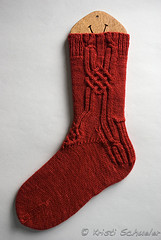
Three of Diamonds Heel Details Three of Diamonds

DSC_8660wtmk.jpgBoth yarns were great to work with. The Misti Alpaca sock yarn is fantastically soft and the colors are nice short bursts with a definite main color so there were no concerns about pooling. It was not splitty or hard to cable and I ran into no knots. It was, as I stated before a photography challenge. It is hard to photograph fuzzy yarn and it is hard to photograph dark yarn - especially when photographing knitting. Combine the two and it is near impossible. The pattern does show up in that yarn in person, though alpaca yarn will never yield crisp stitch definition. I enjoyed knitting with the yarn so much that I do have some in my stash that I’m looking forward to pulling out at some time. Perhaps some Herringbone Ribs of my own?
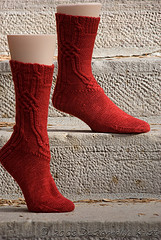
Three of Diamonds on StairsMiss Babs Yummy yarn was fantastic to work with. Her Monochromes (semi-solids) are solid enough that they don’t fight any stitch patterning you may want to use, but there is enough variation in them to keep it interesting to knit, even with large areas of simple knit fabric. You may recall my talking about knitting with reds a while back and how I’m not much of a red person. It is true. I’m not sure why it is, but it has been that way for a long time. Sandi’s Red is my kind of red. I actually loved working with it and love opening the sock drawer and seeing them pop from amongst all my green and purple socks :-)
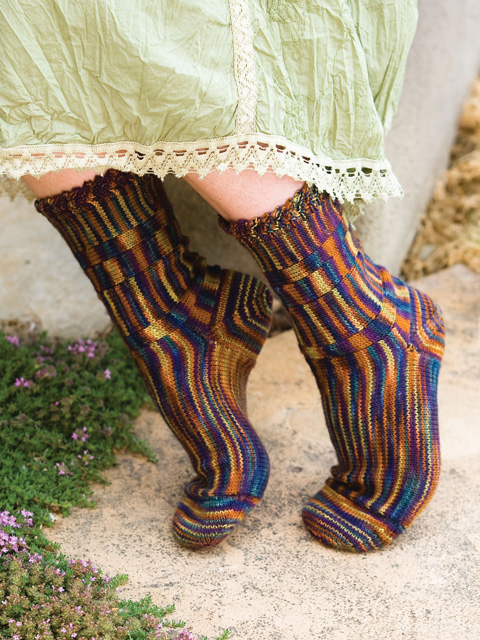
Early 2009 Classes Scheduled!

Filed under: Knitting, Socks, Lace, Classes, Apparel — Kristi at 12:57 pm on Friday, January 16, 2009

I’m excited to announce some fun classes for early 2009. In addition to teaching at My Sister Knits in Fort Collins, I will now also be teaching at Nanytutu’s in Wellington, CO.

Some of the classes on the schedule:

  • Archimedes 3-in-1 Hat - learn top-down, no-swatch techniques for hat and beret knitting, including a variety of techniques for starting and finishing a top-down hat.
  • February Lady Sweater - for those who don’t want to spend hours reading through forums on Ravelry to help choose the right size and modification, sign up for the class and I’ll help you make the decisions right for your body.
  • Triple-T Socks - for those with second sock syndrome, learn to knit two socks on two circs from the toe-up.
  • EZ’s Miters - explore different methods of increasing and decreasing to create miters, then choose your favorites to make Elizabeth Zimmermann’s mitered mittens and ganomy hat from Knitter’s Almanac.
  • Colorwork Hat Workshop - wanting to learn more about two-handed colorwork knitting? Learn the tips and tricks of fair isle knitting while working up a hat in this all-day workshop.

Get more detailed descriptions and the schedule on the Fiber Arts Classes page. Also, for those who use Google Calendar or other calendar or scheduling software you can view the teaching schedule in HTML (and add relevant events to your own Google Calendar), XML, or iCal formats.

The Non-Traditional Spread Spectrum

Filed under: Knitting, Socks, Knitting Patterns, Designing — Kristi at 11:25 am on Thursday, December 18, 2008

© Interweave Press, used with permission - Spread Spectrum socks from Knitting Socks with Handpainted Yarn

© Interweave Press, used with permission

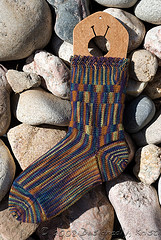
Spread Spectrum is the quickest and simplest (at least in the actual knitting, though some may argue about the construction) of my three patterns in Knitting Socks with Handpainted Yarns.

Spread Spectrum SwatchWhat was the inspiration behind this design? All those skeins of handpaint yarn I have scattered around the house that are just too pretty as they are to actually be knit. Come on, fess up! I know you have them. Spread Spectrum is a pattern that really lets the yarn take center stage and show off the artistry from all the talented independent dyers.

Have you ever noticed how different handpaint looks when it is in a hank where you can see how the dye was applied to the skein? Remember how drastically different it looks after you’ve wound it into a ball and all the colors have mixed? That was what spurred me to knit the leg of this pattern in intarsia strips of varying widths. Changing the stitch count by as little as 2 stitches can make a huge difference in how the different colors lie and interact with each other.

Spread SpectrumThis pattern will work best with yarns that have long-ish sections of color that will pool or diagonally stripe when knit traditionally. The fewer the colors and higher the contrast between those colors the more the construction of the sock will stand out. The Blarney Stone colorway of Socks That Rock used for the book was dyed in a palindrome (A-B-C-C-B-A color sequence) fashion. If the yarn you are using is dyed linearly (A-B-C-A-B-C), alternate the direction of your yarn butterflies for each intarsia strip and you’ll have a higher energy look to the leg of your socks. You could even dig out all those self-patterning yarns that you’ve grown tired of and put them into this pattern for a completely different look.

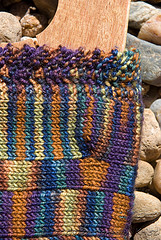
Original Spread Spectrum - Cuff DetailBecause of the non-traditional construction of this sock it is important to pay attention to the note on sizing. Gauge is critical here because stockinette stitch is not nearly as stretchy vertically as it is horizontally. That means for the best fit you need to match your foot circumference as closely as possible to the sock’s circumference and this is done by your row gauge. That makes row gauge of more importance that in most sock patterns. For a snug fit you’ll want to knit the foot 10-15% shorter than your actual foot length. The foot length of the sock is determined mostly by your stitch gauge (the heel and toe are knit normally so row gauge makes a difference in how much those contribute to the length of the foot).

See more of my design work on Ravelry or in my Fiber Arts Store. Don’t forget, today (Thursday, Devember 18th) is the last day to get Guided By Love! After that, the pattern is officially retired!

The Fun and Flirty Longbourn Socks

Filed under: Socks, Knitting Patterns, Designing — Kristi at 2:26 pm on Tuesday, December 16, 2008

© Interweave Press, used with permission. Image of the Longbourn socks from Knitting Socks with Handpainted Yarns by Carol Sulcoski.

© Interweave Press, used with permission.

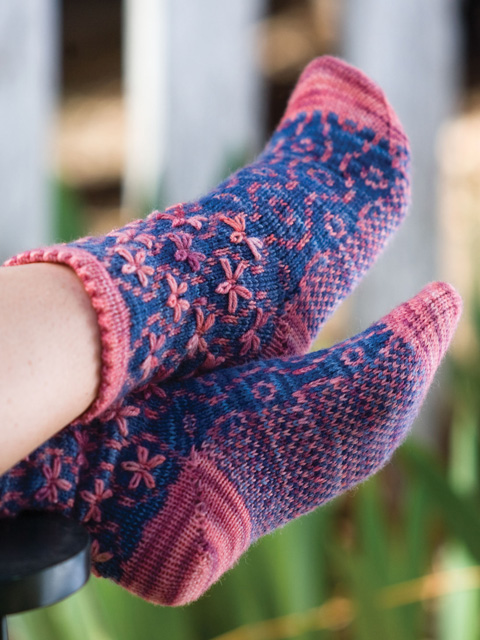
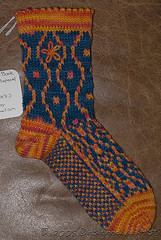
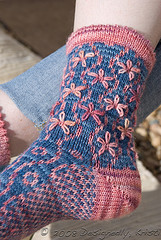
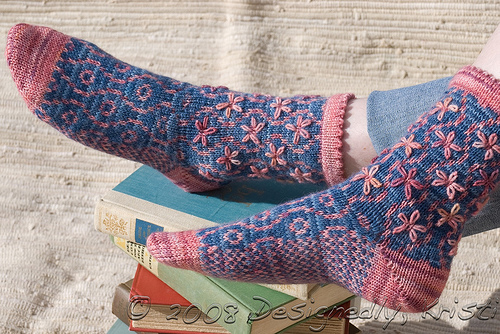
The Longbourn socks (Ravelry) I have to confess are my favorite of the three patterns I contributed to Knitting Socks with Handpainted Yarns. A few months prior to the call for submission proposals I had spent a long day huddled in my basement with DH watching the 5 hours of the BBC mini-series Pride and Prejudice. On this 100th viewing (at the very least I’m sure) of the show the lines of the wallpaper in the Bennet’s dining room at Longbourn really struck a chord with me. They kept popping up in my head over and over again and I kept trying to think of ways to use it in something.

Around that same time a lot of the design work I was doing was for various socks clubs. So far in designing for sock clubs I have never had the option of working colorwork socks, yet I knew colorwork with some embroidery was going to be the most faithful interpretation of the wallpaper in handknit fabric. So, I furiously knit a mini-sock to test out my theory.

Longbourn SwatchThe mini version used an analogous colorway (all colors are neighbors on the colorwheel) of Schaefer Anne handpainted yarn for the main design elements. Since those colors were all warm yellows and oranges I decided to use its complementary color for the background to maximize the contrast - a deep, rich navy semi-solid Shepherd Sock from Lorna’s Laces. It was love at first sight :-) Both Lorna’s and Anne are on the fine end of fingering weight sock yarns and I felt that lent an air of adult refinement to what might otherwise be considered a young girl’s pattern with all those lazy daisies.

Some of you may look at the socks and only see tons of embroidery in your future if you chose to knit these. Let me confess to you that I *loathe* embroidery. I will do it if it is the best means to an end, but I’ll grumble about it the whole time. I certainly do not purposefully seek out opportunities to embellish in such a way. Oddly, it wasn’t a horrible task (though I really drug my feet and knit these socks last). What worked for me was to stitch one round of lazy daisies every time I had a knit enough to fit them on (roughly at each half of a vertical repeat). This kept it from being a monumental finishing task when all the knitting was complete and gave me more room to maneuver the needle while stitching the lazy daisies. With the foot on there and complete it can become a bit of trick to do all that stitching. I highly recommend stitching the flowers as you go!

Longbourn Socks - DetailAnother option for those loath to embroider? Minimized it - just embroider the top level below the picot cuff on each sock. Or, how about a vertical line of them on the outside of each leg or up the back of the leg? Then you could then knit either the instep version of the pattern for the rest of the leg or do the colorwork as originally laid out.

The range of looks for this sock are broad. Even the slightest changes in gauge can greatly influence the feel of the final socks. Heavier yarns will enhance the youthfulness of the sock and lighter yarns will make it look more refined. The color combinations you choose will also greatly impact the feel of the socks. Use two semi-solid yarns to tame the design slightly. Using less contrast (value and/or temperature) between the background and the flowers will have a similar effect, as will using a very dark background color such as the navy in my original mini version. Or find handpainted yarns in Regency era colors to match the pattern with its inspiration! The combinations are nearly endless. You could even use a different color for the lazy daisies than you use for the colorwork if you’ve got some partial skeins lying around in your stash.

Longbourn Socks

I am anxious to knit myself a pair, but I can’t quite settle on colors :-) I’m pretty partial to the original swatch. Then again, I think a dusty sage green with a blue-lavender-periwinkle colorway or just a semi-solid mauve for the flowers would look great. Or, how about a natural cream background and shades of red and burgundy for the flowers? Perfect for Christmas and Valentine’s Day or just to brighten your day in the darker winter months. A nice daffodil yellow for the flowers would have you looking forward to spring each time you slipped them on your feet. Oh, the choices! What yarn and color combos would you knit these socks in?

See more of my design work on Ravelry or in my Fiber Arts Store. Don’t forget, Thursday is the last day to get Guided By Love! After that, the pattern is officially retired!

Herringbone Rib Socks And Their Inspiration

Filed under: Knitting, Socks, Knitting Patterns, Designing — Kristi at 6:27 pm on Monday, December 15, 2008

© Interweave Press, Herringbone Rib Socks from Knitting Socks with Handpainted Yarns, used with permission.

Above Photo © Interweave Press, used with permission

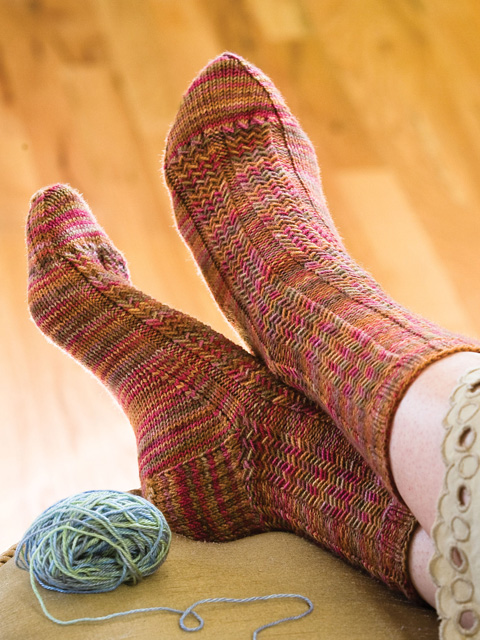
I know many of you have seen the Herringbone Rib Socks from Knitting Socks with Handpainted Yarn already as it was excerpted in the most recent issue of Interweave Knits. Thanks to those of you who recognized my name and sent congratulations already! After nearly a year since I sent off my three pattern proposals the book is officially out! It was in stock at Amazon last Thursday and should be popping up in LYSs and bookstores any day now.
In celebration of the release I thought I’d share a bit of insight into my inspiration for my three patterns that are in the book and my thoughts on yarns that would suit them this week. Keep in mind, I’m not a professional dyer like Carol, the book’s author, and I haven’t seen the book yet so I don’t know exactly what Carol has said about the yarns that suit the patterns. These are just my take on the patterns when I came up with the idea and proposed them to Carol and the books staff at Interweave.

Having come to knitting and spinning via mixed media and paper arts, texture and color are major inspirations to me. I love that knitting can evoke so many different textures and even emulate other types of fabrics.

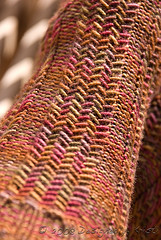
Herringbone Rib Socks - Closer LookI adore the various stitch patterns that look like woven fabric. Often such stitch patterns manipulate the stitches so much that the fabric looses much of the elasticity that it is recommended the pattern be knit on needles two or more sizes larger than you would normally knit a given yarn with. This of course can be done if you knit the stitch pattern in only the cuff, or if you knit your socks on 2-circs and can use the normal size needle for the sole and the large sized one for the instep and leg. Instead, this stitch pattern uses yarn overs to loosen up this woven-look stitch pattern so it can be knit on regularly sized needles.

My love of color has me unable to resist the wonderfully colorful handpainted yarns out there. I do loath pooling/flashing and certain types of diagonaly striping as well which always makes the handpainted yarns a bit of challenge to actually knit with. So when I was first asked to submit some proposals of projects for this book I bounced around a lot of ideas in my head and made many a swatch. Some of my favorite socks knit with handpainted yarns had stitches manipulated in different directions to mix the colors visually. Combine that with a weave-look stitch pattern and I arrived at the Herringbone Ribs pattern.

My swatch for the proposal used a yarn that had a definite primary color and was then speckled with short burst of other colors. This year I knit a sock with a very manly colorway of Misti Alpaca’s Hand Paint Sock Yarn (12 Shadow) which has a similar color approach as that used in my proposal swatch. In fact, I have a skein of that yarn in a different colorway earmarked in my stash for my own pair of Herringbone Rib Socks :-)

The Claudia’s Handpaint that was used in the book worked well. It is a lower value contrast colorway so it produced an overall sock that looked almost semi-solid even though the yarn actually has several distinct colors in it. When it comes to this stitch pattern I think you can hardly go wrong. Even if the colors stripe diagonally, the fact that you are pulling a stitch from a previous round over stitches in the current round helps to smudge and soften those lines. I am itching to swatch it up in a yarn with many colors (8 or more) in very short bursts - something like some of the Koigu colorways perhaps?

There are already many pictures popping up on Ravelry of these socks in progress knit with many different brands of handpainted yarns. There are even a speed demon or two who are done already. It is a blast to see what everyone is using. Go check it out!

Special thanks goes out to Kristi Geraci, 1/2 of the Knitter’s Anonymous blog who knit these socks for the book. There was no way I could knit so many socks and get patterns written up in the time allotted from project acceptance to due date without some help. She posted about her experience on her blog just before Thanksgiving.

« Previous PageNext Page »