Fiber Fool

Follow the feats and foibles of a fiber fanatic.

A Memorial Day Road Trip

Filed under: Photography, Travel — Kristi at 4:16 pm on Thursday, May 28, 2009

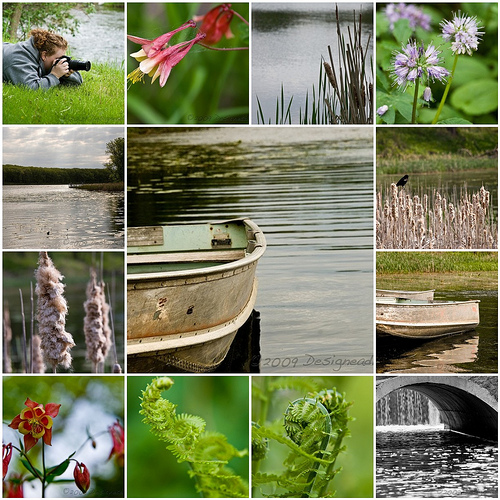
My Memorial Day Road Trip Mosaic

I do not think I mentioned over here, but I am in Minnesota for a visit at my parents’ farm. It had been over a year since I had last been home. On Memorial Day my sister and I got up and out the door by 4am to go to an area state park and get photos of the sunrise. When we arrived, the park was gated. We decided to make the most of our situation and go get breakfast a great greasy spoon truck stop nearby only to find out they did not open until 6am. So, we turned around and headed back into town to breakfast at Perkins to waste some time before heading out to tour the areas to the northwest of us.

We stopped at Swift Falls County Park, Glacier Lakes State Park, Historic Terrace Mill and ended at Sibley State Park and crashed back at home around 1:30 after stopping at the greasy spoon for lunch and phenomenal pie. The highlights of our photocentric roadtrip are in the mosaic above. You can check them all out, plus a few, on Flickr.

We’re going to camp (and I use that term loosely) at Sibley on Friday night in hopes of catching a colorful sunset and sunrise, so positive vibes of such sent our direction are greatly appreciated :-)

Good Times & Good Food

Filed under: In the Kitchen, Fibery Friends — Kristi at 6:03 pm on Tuesday, May 19, 2009

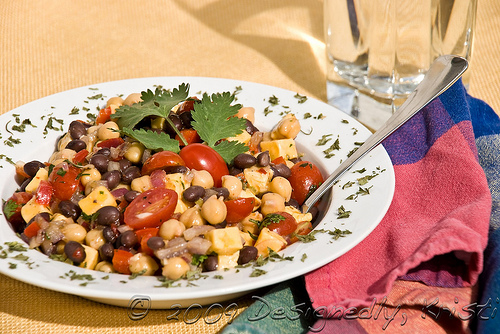
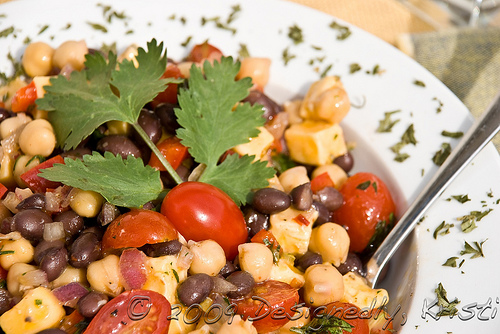
Ensalada de dos Frijoles

On Monday the gals whom I knit with in the afternoons had an all day “sock-in” that was hosted by the lovely Rahchayl (who was hiding the fact that her birthday is on Friday). She has a great place with copious shade in the backyard that looks out onto pasture that houses a few horses. It was a perfect location to spend our first 90 degree day of the season.

The trick with 90 degree days and potlucks is something that will survive the heat. One of my favorite dishes to bring is a bean salad from The Border Cookbook, a James Beard award winner. It is called Ensalada de Dos Frijoles and is free of meats, mayo and other ingredients that can be dodgy in warm weather. It is also naturally vegetarian (and easily vegan if desired) so most can partake in it. Several people asked for the recipe so I figured I post it while I was typing it up. The version here is with the changes I’ve made.

Ensalada de Dos Frijoles

(adapted from The Border Cookbook)

For the dressing:

  • 6 Tbl Extra Virgin Olive Oil
  • 2 Tbl Fresh Squeezed Lime Juice
  • 1 tsp Prepared Dijon Mustard
  • 1 Chipotle Pepper in Adobo, minced fine
  • 1-2 tsp Adobo Sauce (I use 1 tsp for potlucks which most everyone can handle, but I really like heat of 2 tsp)
  • 1/2 tsp Cumin, toasted and ground
  • 1/4 tsp Dried Sage Leaves, crumbled
  • 1 Clove Garlic, minced fine
  • Salt and Pepper to Taste

For the salad:

  • 1 14-oz can Chickpeas, drained and well rinsed (or 1 1/2 cups cooked)
  • 1 14-oz can Black Beans, drained and well rinsed (or 1 1/2 cups cooked)
  • 3 oz Medium Cheddar or Pepper Jack Cheese, cubed to same size as chickpeas
  • 1/2 Red Onion, finely diced
  • 1 Red Bell Pepper, finely diced
  • 1/2 Pint Grape Tomatoes, halved
  • 3 Tbl Fresh Cilantro, chopped

Combine all dressing ingredients in small bowl and whisk well. Combine all salad ingredients except cilantro in a large bowl. Pour dressing on top, stir and chill overnight. Just before serving add the fresh cilantro.

For those who dislike beans, I’ve also adapted it by replacing the beans with rotini pasta and grilled chicken breasts that had been seasoned with a touch of salt, cumin and oregano. I also added some chopped black olives for some additional color.

The dressing is real versatile. Use it to make a nice southwest inspired cous cous salad with many of the same vegetables plus perhaps some jicama! Or even have it just over simple baby greens with or without some chicken. I expect it would make a nice marinade for chicken or tofu as well. Experiment and have fun!

Ensalada de dos Frijoles

Long Time No Blog…

Filed under: Knitting, In the Dirt, Designing — Kristi at 4:35 pm on Friday, May 15, 2009

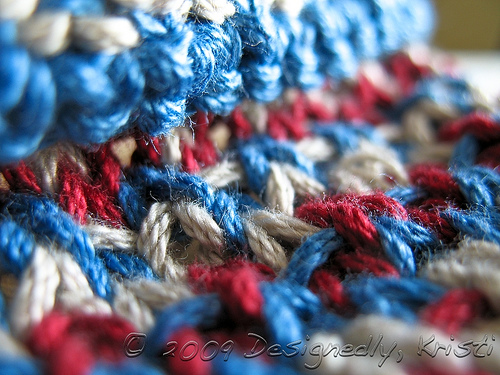
Secret WIP

I’ve been having lots of shoulder/neck trouble again which has put a wrench in both knitting and computer time :-( I’m hoping I’m on the way to mended.

The break from knitting and computing has given me a bit of time to get the garden going. Fortunately, gardening strengthens a lot of the muscles that are currently weak from all the forward work of typing and knitting. In fact, several of the PT exercises from the last flare up were named after gardening tasks. So far, the north beds are all done and plants have been procured for at least one of the west beds.

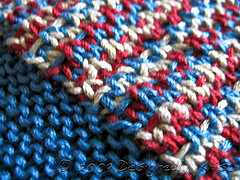
Secret WIPWhile the weather here is not yet sweltering (knock on wood), I know it will not be long before I’m wishing we had AC. So, my mind has been turning towards both cotton and smaller projects lately. The photo above is of a secret project I’m working on at the moment. I’m using three different colors of Tahki Cotton Classic, a 100% mercerized cotton dk weight yarn. I’m a little bummed that my row of single crochet did not stop the curling… I’m thinking I’ll shall need to do more crochet around the edge, but have not yet decided whether to continue with the blue or do one row of each color. It’s in time out until I decide!

What are your favorite types of hot weather knitting? Or do you give up knitting in favor of other warm weather activities in the summer?

Check out more Fiber Arts Friday Posts at Alpaca Farmgirl’s blog!

Exploring Knitting Techniques

Filed under: Knitting, Classes — Kristi at 12:02 pm on Monday, May 4, 2009

Knit Voyagers In Progress

My mom always said that as soon as I learned everything I needed to know about something I pack it in and move on. Looking back, I think there is some truth in what she said. Perhaps what has kept me knitting and taking photos for much longer than most of my other hobbies is that there is *always* something new to learn with these topics. My design portfolio can best be described by the fact that I touch upon many different types of techniques and approaches to construction such that there is often something new to learn in any of my patterns - toe-up socks, top-down socks, circular knitting on DPNs, top-down hats, an unusual way to avoid holes in thumb gussets, cables, lace, traveling stitches, stranded colorwork, intarsia, non-traditional constructions and on and on.

Those of you who know me in real life or have been lurking here on the blog for a length of time likely know I am one of many scientists turned knitting designer. It seemed only natural to combine my scientific nature with my enjoyment of exploring new techniques and create a series of technique-based classes.

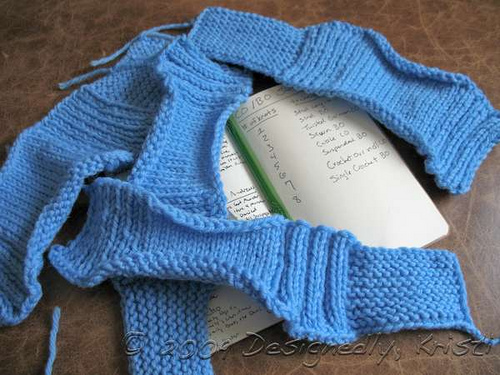
Starting this week (and likely to be repeated in the later summer and/or fall) I am starting a series of classes at My Sister Knits called Knit Voyagers. Each class is a stand alone 2-hour class. You can take 1 or all 4 that are currently in the series. This week we’ll be embarking on the exploration of cast-ons. In preparation for these classes the past few weeks I’ve had my head buried in all the classic knitting reference books. I’ve been knitting swatch after swatch after swatch so there are many examples to fondle and stretch and pull on so we can observe the elasticity, durability and overall aesthetic of each cast-on. Each swatch when appropriate contains 1×1 ribbing, 2×2 ribbing, garter stitch and stockinette stitch. While the swatching at times can seem tedious, the ability to compare cast-ons side by side and make notes about their various properties makes my scientific side sing!

If you are interested in embarking on such an exploration but can’t do so with me, I have a few tips. Firstly, the single knitting reference book I’ve found with the most cast-on and bind-off techniques is Montse Stanley’s Knitter’s Handbook : A Comprehensive Guide to the Principles and Techniques of Handknitting. It is fantastic. I do struggle a bit with the illustrations, but that is normal for me. She covers a large number of cast-ons - some with many variations. There are even a couple pages categorizing which cast-ons are appropriate for certain knitting situations. Even if you’ve been knitting for years, there is valuable information in these pages!

My second tip involves keeping track of the swatches. You’ll notice there are no tags present on the swatches in the photo. That is because they are all unblocked as of the taking of the photograph. Yes, blocking can sometimes seem tedious, but one cannot accurately judge the properties of a cast-on (or bind-off) without properly finishing it. But, tags are not waterproof. How do you keep track of what technique was used on each swatch? Wash each one separately? No way! See the notebook tucked under there? That is my key. In the tail from the CO I tied a certain number of knots. The same with the BO tail. Each time, I tied one more knot. The notebook is a record of how many knots in each tail mark which CO or BO! Then once the swatches are dry I can put my tags on so I don’t have to dig up my notebook with the key each time I want to reference my swatches when starting a project. I have now gotten up to a ridiculous number of knots to tie so I’m going to tie in place a small hair elastic (they are cheap and easily replaced) to represent my tens.

If you are curious what other topics we’ll explore in Knit Voyagers the first session is Cast-Ons, the second is Bind-Offs which will be next week. In June we’ll look at Directional and Paired Increases and Decreases which are important when working fitted garment or raglans. That will be followed by Center-Out Cast-Ons (think Turkish, Figure-8, Emily Ocker etc.). By the end of this initial series someone taking all four should have much knowledge in making sure their handknits are the best they can be.