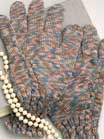
Socktoberfest: Yarn Reviews…
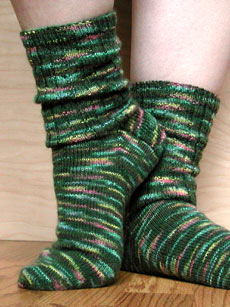 Opal Sock Yarn
So far I’ve made one pair of socks from Opal. Opal fingering is 75% wool and 25 % polyamide for additional durability and washability. It was my first pair of sock-weight socks as well as my first completed pair. I found Opal very nice to work with. It felt good to my hands both in softness, thickness, and give. I like that one ball will make a pair and one ball has a pretty decent price tag of $16 - $20 for the print version. Prices vary on their other weights or styles.
The label says to machine wash and dry. I did that the first time and would not recommend the machine drying. I experienced a similar fate on these socks as Grumperina recently mentioned - fuzzing. I now put them through a machine washing in a lingerie bag, but I lay flat or hang them to dry naturally. They haven’t really pilled though, despite all that fuzziness, but they do look more worn because of it. Despite my frequent wearing of them for two years now there appear to be no signs of thinning on the high wear spots of bottom of heel, ball of foot, or back of heel.
I have two more balls of Opal in my stash, both recieved as gifts or prizes this spring/summer. I’m looking forward to knitting them both!
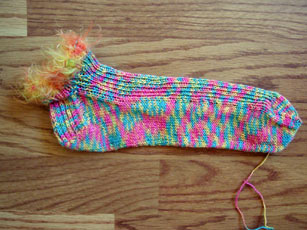 Sockotta Sock Yarn
Sockotta yarn is brought to us by Plymouth. It is 45% cotton, 40% superwash wool, and 15% nylon. Like Opal, it is put up in 100 gm balls so one ball gets you a standard pair of socks. A ball will put you back around $9, so it is even more economical that most sock yarns.
Now, you might notice that this picture doesn’t show a pair of socks. Well, that is for a reason. I found the Sockotta very unpleasant to knit with. It is well spun so it did not split. However, the high cotton content left the yarn with very little elasticity and it didn’t feel as nice running through my hands while knitting. I’m somewhat prone to tendinitis in my wrists and this yarn did not help that cause so I never finished the pair.
Since I didn’t finish the pair I can’t comment on the durability, but I suspect it is pretty good since they did make sure to add some nylon and as I mentioned previously it was spun quite tight.
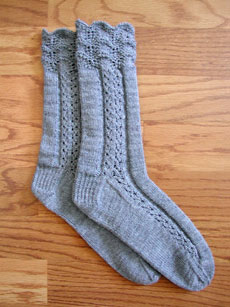 Lang Jawoll
Lang Jawoll is a superwash yarn with 75% wool, 18% nylon and 7% acrylic. The label recommends machine washing and lying flat to dry. Each skein is 45 gm with a matching 5gm spool of reinforcing thread/yarn. This means you need two balls for a standard pair of adult socks, you may need three for large man feet. But, at about $7 a skein it still is an economical choice for sock knitting with wool that is machine washable.
Jawoll comes in a rainbow of solid colors, making it one of my first choices when seeking a specific solid color yarn. It also comes in a variety of others types and prices may vary slightly based on that.
I really found knitting with it to be a positive experience. It was spun nicely, it retained a nice elasticity and it held up to some repeated frogging while I was designing Spearfish. I cannot comment on how it has held up to wear as the Spearfish socks were knit for Sockapalooza, but given the constuction and make-up of the yarn I suspect it has a good durability.
 Regia Stretch
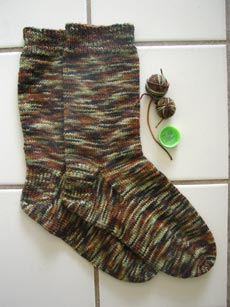
Regia Stretch is 70% new wool, 23% nylon, and 7% polyester in 50 gm balls. You’ll need two balls for most adult socks. Though if you note in the picture, there is very little leftover and that was after knitting what I would consider a medium sized pair of men’s socks. They were knit on US 2s.
I found Regia Stretch to feel good to my hands when knitting it. I had no trouble with splitting and it had a nice elasticity that was easy on my hands. I also loved the fact that the varigation used by Regia didn’t cause wierd pooling or flashing in the gusset area as is so common with many handpaints or other varigated yarns. DH wears this pair of socks quite frequently and has had them for over a year and I’ve seen no signs of thinning in the usual spots so far. We again machine wash them in a lingerie bag and hang to dry naturally.
I wouldn’t hesitate to pick up more of this if I come across inspiring color combos again.
 Cascade Fixation
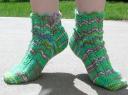
Cascade Fixation is a cotton and polyester blend that is very elastic. It is sold in 50 gm balls, but it is a heavier weight yarn so if you wish to make more than adult anklets you’ll need at least three balls.
This is one of the more pleasant cotton yarns that I’ve knit with due to the high elasticity. However, it is much too heavy for summer socks in my opinion. They are very thick and because it is cotton and you have to use larger needles with it I find it uncomfortable on my feet for any sort of extended wear - especially if I’ll be doing lots of walking.
The yarn is spun nicely so I didn’t have troubles with splitting. It does take a while to get comfortable knitting with a yarn that is that elastic. For your first time working with it I’d highly recommend knitting a very sizeable swatch to settle into what you guage will be when working with this yarn. It will almost invariably change once you’ve gotten accustomed to the yarn. Also due to the high elasticity I find it is very hard to match guages on patterns written for it unless they give you info on how to calculate your gauge (as I did with Heatwave) because each person deals with the elasticity different when knitting with this yarn. Some pull all the elasticity out of the yarn while forming the stitches and others don’t stretch it all and then there is of course everything inbetween. So just be aware of that.
I have four more balls of it (in two colors) in my stash. I’m sure I will eventually use it, though it isn’t likely to be anytime too soon. There is also a good chance they won’t grow up to be socks.
 Mountain Colors Bearfoot
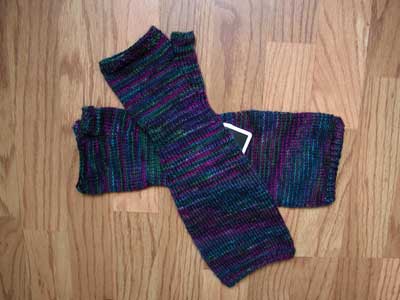
I have not knit socks from Bearfoot - yet. So I cannot comment on the durability of it in terms of socks. But I thoroughly enjoyed knitting with it. Bearfoot is 60% superwash wool, 25% mohair, and 15 % nylon that is machine washable. It runs around $20-24 per hank so it isn’t the most economical of sock yarns but it isn’t out in left field either. One hank will get you a pair of adult socks with some left over for mending in the future. As with any sock yarn I’d highly recommend air drying. Both the mohair and the nylon should give this yarn a very nice durability for socks.
The yarn is handpainted in often very rich colors - some earthy or some jewl tones such as my gauntlets. Because it is handpaint it can sometimes pool or flash depending upon your stitch pattern and often the look of that pooling will change in the gusset area of the sock if you use the heel flap method of sock construction. The yarn is not spun as tight as some sock yarns, but I had no troubles with splitting. It felt really nice flowing through my hands as I knit. The mohair content does give it a bit of a halo that along with the handpainting could swallow up very intericate stitch patterns.
I have one more skein in my stash and I definitely look forward to knitting with it!
 Koigu PPPM
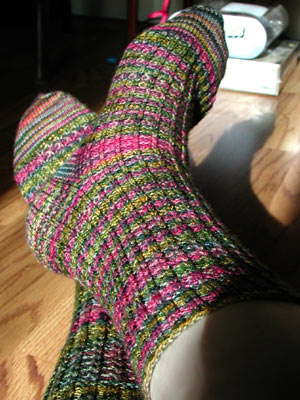
Koigu Paint’s Palette Merino yarn is a 100% merino and feels heavenly running through your hands as you knit. It is recommended that you hand wash it since it is 100% merino. That said, my Flatiron socks get washed in the machine in a lingerie bag and air dried and they show no signs of pilling, fuzzing, felting or the like.
I’m sure my point of view won’t be a popular one. I won’t be rushing out to buy more for socks. Like some merino yarns this one is plied at a sharper angle than many yarns and it ends up feeling kind of hollow. Now, trapping air into the yarn makes it that much more warm, but I found the yarn compressed dramatically when knit and it just didn’t feel good to me. It also meant that I felt I needed to go down to very small needles to get a fabric I felt would hold up as socks. It does have a lot of elasticity which is great for socks, but I had almost similar troubles with the KPPPM as I did with the Fixation. My two socks are nearly two different sizes because I finally settled into the way to handle the yarn when knitting with it.
KPPPM is also relatively expensive and it would not be unusual to need to use three of $12+ hanks to get a pair of adult socks with generous length legs. That makes for an awful pricey pair of socks. The color combinations of the handpaints are gorgous, but I find they are often too dramatic to pull off many stitch patterns. The solids and semi-solids can look gorgeous though.
 Knit Picks Color Your Own 100% Merino
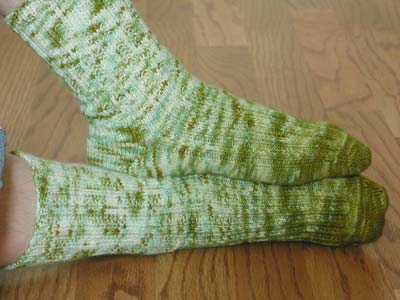
Knit Picks’ 100% merino wool was not spun or plied like many of the 100% merino yarns. It had a standard 100% wool hand to it rather than the extra high elasticity and hollowness of yarns like KPPPM, but because it wasn’t spun as tightly this yarn felts very easily. Looking at it wrong can almost cause it to felt. That is very disappointing after you go to all the added effort to dye it uniquely.
The yarn did take up dye quite nicely and it feels nice to knit with, but it is really a shame to put in so much work dyeing, designing, and knitting only to have the socks shrink in the first washing. Now, I can still get them on, but they fuzzed up a bit and don’t look nearly as nice as my other handknit socks. Because of the need to handwash these they don’t get as much wear as my other socks, but so far there has been little indication of thinning. Aside from the felting issue they have held up well.
I have a few more skeins of this and will definitely dye it up and knit with it. I may choose to knit something that doesn’t need as frequent washing as socks though - scarf, mittens, hats etc.
 Trekking XXL
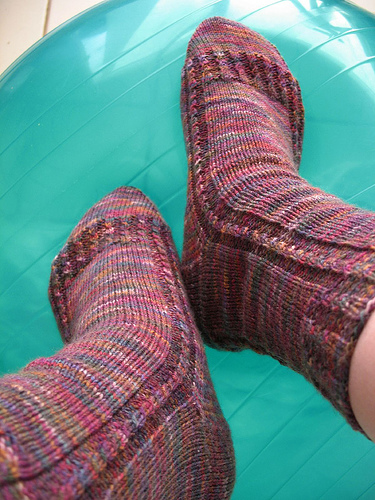
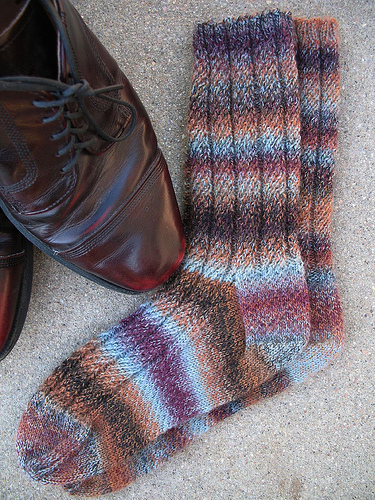
Trekking XXL is a 75% superwash wool and 25% nylon sock yarn that is usually packaged in 100 gm balls which will make a pair of adult socks of nearly any size. At about $14 per ball this is a fairly economical sock yarn. It washes well in a machine when air dryed. Both of these pairs were knit for the Trek Along this summer so they haven’t gotten a ton of wear yet, but there has been zero fuzzing and they look almost exactly as they did when they came off of the needles.
Trekking XXL is most known for their unrepeating ombre striping that goes great with ribbed patterns, but they also produce varigated, jacquard, barber poled, and heathered varieties. I was again inpressed with the varigated version as there was no pooling or flashing, even in the gusset area of the sock!
I did occassionally find some thin spots in the yarn and also found it could be a bit splitty at times. I ran into a tangling ball as I’d near the end of the second sock on both pairs that got kind of tiresome. Despite these troubles I will certainly be knitting with Trekking again in the future. I had one ball in my stash yet and I picked up another last week. I found the final product to outweigh the slightly negative aspects.
I have used various sport weight yarns for socks as well, but I won’t bother reviewing those as most find them too bulky. I will continue to seek out new and different sock yarns to use in the future. I know I still haven’t knit with some of the “hot” ones right now - Lisa Souza, Socks that Rock, Lorna’s Laces, etc. Please share with me your opinions of the sock yarns you have used either here in the comments or leave a link to a post on your blog. Review week of Socktoberfest is nearing the end!