
An Introduction to Color Theory
Note: It is important to note that dealing with color on the computer screen is quite different than dealing with it in paint, markers, crayons, pastels, pencils etc. There is a limit to the number of colors that can be represented accuratly on a computer monitor and each monitor will desplay colors differently. On that note, please do not take these graphics as the definitive in color theory, but rather as a crude example that is not real accurate in the world of artistic mediums. I hope you find these examples helpful to you in understanding color and how to use it.
The Color Wheel
As the name implies, the color wheel is a continuous wheel of color. It starts out with the three primary colors. Primary colors are colors that cannot be made by mixing other colors together, but instead can be mixed in varying proportions to create any of the other non-primary colors. The three primary colors are red, yellow and blue.
 Here is an example of a primary color wheel. It contains only the three primary colors - red, yellow and blue. |
If you mix each of the primary colors in equal proportions you get the three secondary colors. These three secondary colors are orange, green and violet. These six colors together make up what we traditionally think of as the rainbow, though in reality the rainbow in nature does not have distinct lines between the colors so all colors are present.
 This image is an example of a secondary color wheel. A secondary color wheel contains the three primary colors - red, yellow and blue - as well as the three secondary colors - orange, green and violet. |
Taking yet another step, we arrive at what is commonly called the tertiary colors. Once again, you combine neighbors in equal parts to arrive at the 6 tertiary colors of red-orange, orange-yellow, yellow-green, green-blue, blue-violet, and violet-red.
 The teriary color wheel contains the six colors of the secondary color wheel, plus the 6 tertiary colors - red-orange, yellow-orange, yellow-green, blue-green, blue-violet, and red-violet. |
What about white, black, brown and gray? Well, it is commonly said that white and black are not colors. When dealing with light, white is the presence of all colors and black is the absence of all colors. Now, in the art world when you are blending various mediums to make colors you can't throw all colors together to make white or leave all colors out to make black. This is because we are mixing pigments and not light. Anyone who has run theater lights can add and subtract colors to make white and black light though. In paints and other pigmented materials white and black are additional colors, but not officially part of the color wheel. Because they are not officially part of the color wheel they can be used in any color scheme, which we'll discuss more towards the end of this tutorial.
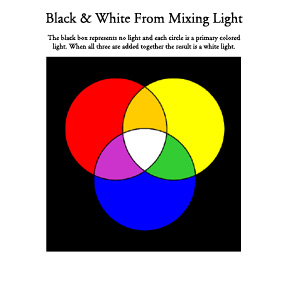 In this image, the black box represents no light and each circle is a primary colors light. When the primary colored lights are all added together, you get a white light. This does not hold true when mixing pigments. |
Brown and gray can be a bit confusing, but in general you get a gray if you combine complementary colors (those colors directly opposite each other on the color wheel I'll get into more detail on these later). Now, there are warm grays and cool grays. Warm grays are sort of taupe or brown colored and cool grays have more of a feel of blue or black to them. So, by combining the complementary colors in equal proportions we arrive at our grays and browns.
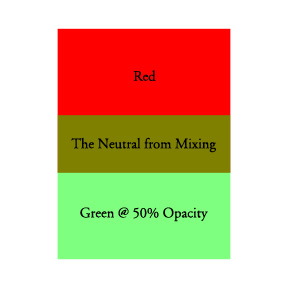 Here you can see a how mixing red and green together on a computer screen creates a neutral color. Shades may vary from mixing pigments, but this rule holds true - when mixing complementary colors you will get a neutral color, either warm or cool. |
The color wheel is the basis for all color schemes. I highly recommend owning one of some variety or another. If you do a lot of watercolor work I suggest a watercolor one. It's a great thing to play with when you feel stuck in a color rut and can be helpful in analyzing color schemes from nature, advertisements and such. Most art supply stores have them, as do the on-line art supply places. Even the large craft chains have them and they are under $5.
You can also mix your own with your usual paint medium. Make yourself a large circle and split it into 12 pie pieces (kind of like a clock for that matter). Then start by applying your primary and then mixing your primary colors together in equal amounts add the secondary colors. Then, mixing the one primary with the next closest secondary color add the tertiary colors. Ta-da! You have you own homemade color wheel by only using 3 colors!
Intro to Color | Tutorial Index | The Color Descriptors