Fiber Fool

Follow the feats and foibles of a fiber fanatic.

Infinite Scrunch Available Now

Filed under: Freebies, Knitting Patterns — Kristi at 12:19 pm on Monday, February 14, 2011

Peek at Infinite Scrunch

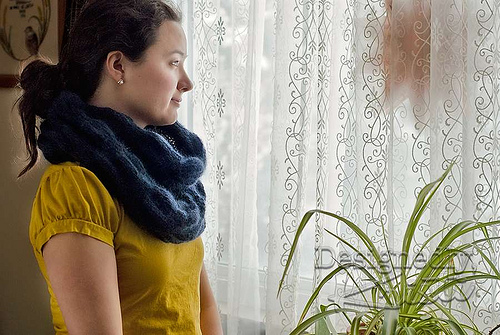
Infinite Scrunch is now available! It is a FREE pattern, part of My Sister Knit’s February/March newsletter, which can be downloaded at http://www.mysisterknits.com/newsletter-archive.

I opted to make this infinity scarf generously sized so that it could also be worn as a shrug. It fits Amanda beautifully. If I were to knit one specifically for me and really wanted to wear it in the shrug style, given my plus size I’d purchase an extra ball of yarn and do an additional 2-3 repeats. I can wear it as is, but it doesn’t have the drape as shown here.

Infinite Scrunch

This version is knit from 4 balls of Rowan Kid Classic, a blend of wool, mohair and nylon. You could also carry a mohair yarn along with a DK or worsted weight wool yarn. I can envision using two analogous colors for a nice depth of color. Or, carrying a solid color with a variegated one. Other fuzzy yarns, such as those with camelid yarns (alpaca, llama, camel) would create a similar look and feel as well. You’ll want about 625 yards.

I used larger than called for needles - US 10.5 to increase the drape of the final fabric so it was flexible and light enough to be scrunched and worn in the variety of ways one can wear an infinity scarf.

I love this scarf and am so sad that I had to give it up to be on display in the store. I wore it a bunch until I dropped it off. I’m very tempted to cast on another as it is fantastic TV or SnB knitting and I don’t always have a project like that on the needles. The only question is what color… Hmmm…..

Friday Freebie for Family Fun - 1,000 Blank White Card Printables

Filed under: Freebies, Games — Kristi at 3:25 pm on Friday, January 21, 2011

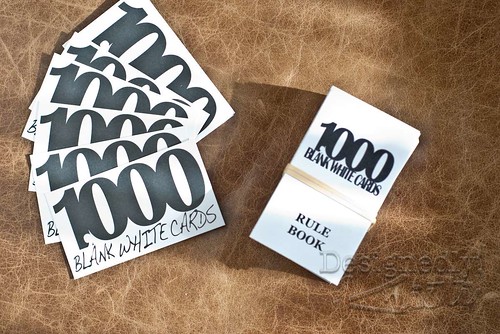
Our 1,000 Blank White Card Set

We enjoy games around these parts and I always have (see Tuesday’s post for proof). We play all sorts of games from some of the classic Cheap Ass games to involved games like Arkham Horror. We enjoy playing classics from time to time like Backgammon and Drew is a big fan of Go. Several years ago we were told about a build-your-own card game called 1,000 Blank White Cards (1kBMC). We introduced it to our game playing friends and it was a hit.

The basic premise of 1kBWC is that you build your own deck cards, traditionally from index cards cut in half. 1/3 of the deck are already drawn cards from a “seed deck” of previous games that were voted to be carried forward by that game’s players, 1/3 of the deck is drawn before dealing the cards and a 1/3 are blank cards and drawn as the game progresses. If it is your first 1kBWC game you’ll just draw 2/3 of the deck before the cards are dealt.

If you’ve ever played Flux, that is kind of how this works. Each card must have a title and drawing on it and either a point value or an action that applies to either an individual or the table as a whole. Once the entire deck has been played the game is over and the winner is the person with the most points - that is unless someone draws a card that changes those rules!

For Christmas this year gifts were optional and if done were to be homemade. I don’t know about you, but men can be hard to gift to anyway, let alone with the restriction of it being homemade. And our preserves were going to the women. We didn’t know if all the men played games, but we knew a few did. So, I designed a little logo for 1,000 Blank White Cards that we had printed on business cards. Then I created a little rule book that is the same size of the business cards so it can be stored with them. Put together, we gave people 500 cards to start their 1kBWC decks. That should be enough for many games as the deck is usually made up of 15 cards per player.

Well, I went to all the work and we’re not likely to get to make use of it again anytime soon. It seemed a bit of a waste of time and creative energy. That was until I realized I could share it! So you can download the cards and/or the rule book and create your own 1000 Blank White Card set for yourself or gifting. The cards should print on business card paper, though I recommend you test it on plain paper and hold it up to bright light with your business card paper to double check. You can also print the cards on heavy cardstock and cut them to size with a paper cutter.

The rule book is two pages that need printed back to back. Instructions on how to cut and fold the book are included in the file. I recommend a slightly heavier bond of standard printer paper. Cardstock is a bit too stiff for nice clean folding, but too light of a paper doesn’t hold the creases as well and you can sometimes have text bleed through.

While we’ve only played the game with adults, I think this would be a great game for the whole family. Since you create it as you go it can be created to suit the individual players. In fact, we discovered if you play with two drastically different groups of people it is nice to have a seed deck for each type of group.

If I’m ever stuck for card ideas I like to draw on pop culture references - song lyrics, movie quotes, famous books or characters. Others like to draw upon other game actions they can think of. Above are a few sample cards from our seed deck.

Well, what are you waiting for? Start drawing and playing!

New Free Pattern!

Filed under: Knitting, Freebies, Socks, Knitting Patterns — Kristi at 10:13 am on Wednesday, June 4, 2008

I told you knitters to have some patience, didn’t I?? Well, here you go!

It has been a while since I had a free pattern to add to the site. But I’m finally sharing the Triple T sock pattern that I just finished teaching at My Sister Knits. I held back on releasing it here because, as I figured, I was able to add in a few little details that the students in the class asked about. With the verbose version, most adventurous knitters should be capable of teaching themselves how to knit two toe-up socks on two circulars using a Turkish cast-on, wedge toe, inverted heel flap and gusset and EZ’s sewn bind-off.

All Four Triple T Sample SocksAlready know how to knit two toe-up socks on two circulars? There is a less detailed version that is more like my normal sock patterns.

Both versions have fifteen sizes and seven gauges as well as four different ribbed stitch patterns you can plug into the sock. The sizes and gauges are presented in tables similar to the Knitter’s Handy books by Ann Budd. The covered gauges range from 7-10 sts per inch in 1/2 st increments so it covers lighter sport weight/heavy fingering to light fingering on needles of US00-US2 or so for most knitters.

Check it out on Ravelry! Or see more pics of the toddler sized ones shown in this post on Flickr.

Hot! Hot! Hot FOs!

Filed under: Knitting, Freebies, Finished Objects — Kristi at 9:10 am on Tuesday, July 17, 2007

To make up for the boringness that has been my blog lately I offer up a couple instant gratification FOs…

Pattern: Iced Java Jacket (Seed Stitch Version)
Designer: Chris of Stumbling Over Chaos
Yarn: Cascade Fixation 4448 (from Nanytutu’s)
Needles: 2 Addi Turbo 16″ circs in US 3
Mods: Because I had US3s handy and not 4s I cast on 43 sts and knit about 24 of the plain st st rows. Next time I might go up to 45 or possibly 47 sts as it can be a bit of a struggle to get the sleeve on the cups from the area shops.

This was my jump back into knitting as my split finger was healing project. I know Knitter Sansablog had a pretty good laugh at me last week when I mentioned that it was nice to know that knitting with larger needles made a big difference on being able to knit. I do know that US3s are not really “bigger needles”, but in comparison to 0s and the ease with which the different sizes can puncture your callouses it is a big difference.

Pattern: Shifter Sock (see below)
Designer: Myself
Yarn: Cascade Fixation, 4448
Needles: 2 Addi Turbo 16″ Circs in US3
Gauge: 5.5″ per in in st st

I used the java jacket as my gauge swatch for the Shifter Sock. I then took measurements of the gear shifter. The stem portion was about 4.5 inches in circumference for about 1.5 inches and then it started to morph into the handle portion that was about 5.75 inches around, but it is not centered on the stem. In stead the stem morphs into the top almost straight on the back side of the shifter. This gave me the idea to make the cover like a snub-footed sock rather than a stocking cap as I was originally thinking.

I believe this sock fits both of our vehicles which are of different years and manufacturers. The elastic in the yarn gives you a lot of leeway, but adjustments can certainly be made to fit shifters that are shaped differently.

Shifter Sock Pattern

Use your preferred method of knitting in the round - 4 or 5 DPNs, 2 circs, or magic loop.

Cast on 24 sts, join and knit 10-14 rows of k1p1 ribbing (shown is 10, I’d go to 14 next time).

Knit 3 rows of st st.

Inc 4 sts evenly around the sock on nxt rnd.

Knit 3 more rows of st st.

Work your favorite short row heel method over 16 sts (or 1/2 the total sts plus 2) with 6 unwrapped sts in the center before completing the second half of the heel.

Knit 4 rows of st st.

Redistribute sts evenly before starting the decreases.

Dec Rnd 1: K1, ssk, knit to 3 sts before the end of the first half of sts, k2tog, k1. Repeat for second half of sts.

Knit 1 rnd, then repeat dec rnd 1 for every rnd until 8 total sts remain.

Kitchner the “toe”, weave in the ends and cover your gear shifter!

I think I may turn mine inside out, stretched nearly to the max and paint some hardware dip on the inside so it doesn’t slide around on the shifter.

FO Friday: The Sea Edition…

Filed under: Knitting, Follow the Flock, Freebies, Finished Objects, Knitting Patterns, Lonesome Skein — Kristi at 3:42 am on Friday, November 3, 2006

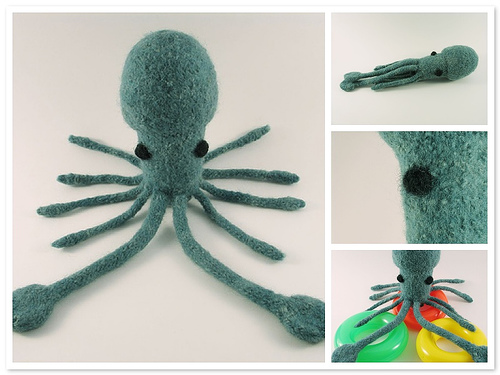
Shoney the Squid

Pattern: My Own Based Loosely Upon the Naughty Squiddy
Yarn: 1.5 oz of left over Manos del Uraguay & a few yards of Black Lamb’s Pride Worsted
Needles: US 9 DPNs
Misc: Felting Needle, Darning Needle
Recipient: Spleeben, a friend of ours who is squid crazy!

Notes: I was going to follow the Naughty Squiddy pattern, but decided it needed some adjustments if I was going to felt it fully and stuff it rather than use it as the cover I’m assuming it was designed for (based on the name). I ended up making quite a lot of changes and will note them here so if anyone should wish to make their own felted Shoney you can…

Supplies:

~75 yd worsted weight feltable wool in color of your choice
~3 yd worsted weigth feltable wool in black of eye color of your choice
US 9 DPNs
Darning Needle
Felting Needle (recommended)
Polyfill

Make One of the Following (Body):

CO 26 sts onto 4 DPNs
Rnds 1-4: Purl.
Rnd 5-6: Knit.
Rnd 7: Purl.
Rnd 8-23: Knit.
Rnd 24: Purl, incr every other st (39 sts)
Rnd 25: Purl, incr every third st (52 sts).
Rnd 26: K1, ssk, knit to last three sts on ndl 2, k2tog, k1; rep for ndls 3 and 4.
Rnd 27: Knit.

Rep rnds 26 and 27 until 24 sts remain.

Rnd 28: *K1, ssk, k1, k2tog; rep from * to end of rnd.
Rnd 29: Knit.
Rnd 30: *Ssk, k2tog; rep from * to end of rnd.
Rnd 31: Knit.
Rnd 32: K1, *k2tog, k2; rep from * to end of rnd.

Cut yarn, and pass through remaining sts and draw tight. Pass the yarn to the inside and loosely weave the tail in a little. Since it will be felted there is no need to be overly cautious.

Decide which side will be the front of your squid and count off the middle six purl bumps in the lone purl row. This is where the two long tentacles will be attached.
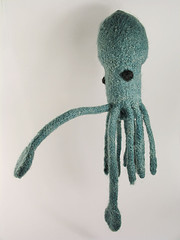
Shoney and a TentacleMake Two of the Following (Large Tentacle):

Use a DPN, CO 3 sts.

Knit 1 st from DPN, pick up one purl bump and knit it, and repeat for a total of 6 sts on the DPN. You can i-cord knit these six sts or knit on three DPns with two sts on each, whichever you prefer.

Rnd 1-33: Knit.
Rnd 34: K frnt and bck of each st (12 sts).
Rnd 35: Knit.
Rnd 36: K frnt and bck of every third st (16 sts).
Rnd 37: Knit.
Rnd 38: K frnt and bck of 1st and 10th sts (18 sts).
Rnd 39-40: Knit.
Rnd 41: *K2tog, k; rep from * to end (12 sts).
Rnd 42: *K2tog; rep from * to end (6 sts).
Rnd 43: *K2tog; rep from * to end (3 sts).

Using a yarn needle, pass the yarn through the center of the tentacle and back out, pull slightly, clip, then stretch the tentacle back out to pull the end of the yarn back into the center of the i-cord.

Make Eight of the Following:

Using the remaining purl bumps on that lone purl row, evenly spaced, pick up and knit three purl bumps for each short tentacle.

Rnds 1-18: Knit in i-cord fashion.
Rnd 19: Purl.
Rnd 20: K1, k frnt and bck, k1.
Rnd 21: Purl.
Rnd 22: K1, k frnt and bck of middle two sts, k1.
Rnd 23: *P2tog; rep from * to end.
Rnd 24: Knit.
Rnd 25: P3tog.

Using a darning needle, pass yarn through center of i-cord, pull slightly, clip, and stretch tentacle back out to pull yarn end into center of i-cord.

Make Two of the Following (Eyes):

Cut two 1-yd lengths of worsted weight black yarn. Decide where you wish to position the eyes. Fold each yd into a triple ply of about 12 inches in length and thread your darning needle. Then make a french knot for each eye, being sure that when putting the needle back through to the inside you do not go back through the same hole you came up as you would in regular embroidery. Tie a square knot on the inside and trim excess yarn. Repeat for the other eye.

Felting
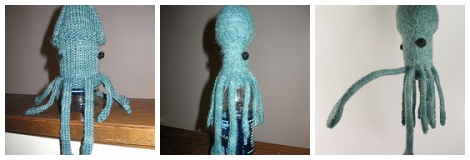
Evolution of Shoney the Squid

I hand felted Shoney in my bathroom sink in order to better control the shaping. Wear rubber gloves and run the water as hot as possible. You can up the temp by adding a kettle of boiling water as well. Add a touch of dishwashing soap (Dawn, Palmolive etc.) and put the squid in the water to soak for 5 minutes. Then agitate with your hands. You can control the shaping and such by the direction you rub it in. If you roll the squid between your hands it will reduce the circumference more than it will reduce the height. Occassionally dunk into a bucket of cold water to shock the wool. This will speed up the felting process significantly. Repeat until the stitchs are obscured to your liking and the size is what you are looking for.

Roll the squid up in a towel and step on it to push excess moisture from the felt. Then stuff the top with plastic garbage bags to shape it and set to dry. I propped my guy on a water bottle so his tentacles could hang freely while drying.

Finishing
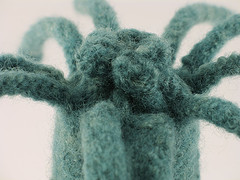
Shoney's ClosureOnce dry, remove the grocery bags and stuff with fiberfill. Then, using some of the matching yarn, take about 1/4 inch gathering sts around the bit of felt that is below the tentacles. Pull tight and then take a few more sts moving across the gather to be sure it is closed up tightly. To make a more seamless look, carefully use a felting needle to blend the new yarn into the felt. You can also using the felting needle to refine some of the shaping and make the french knot eyes blend into the body some more.

Enjoy!
Next Page »