Socktoberfest Tutorial: Converting Sock Patterns to Clog/Sandal Socks (Reprise)
I originally published this in June of 2005 at the old blog. In honor of Socktoberfest’s tutorial week I present a reprise of my directions on how to convert any sock pattern to a clog/sandle sock pattern…
———————————————-
In order to respect Interweave’s copyright, I will not be walking you through the process to covert their Retro Rib sock pattern into clog/sandal socks as I have done and continually recieve requests for. But, if you continue reading you will find a nearly four-page tutorial on how to convert pattern stitches from the leg to flat knitting so they can be continued along the heel for wear with clogs or sandals. I will walk through contiuing a K3, P1 rib, as well as Nancy McGlynn’s Seaweed socks as examples.
First, you might be asking yourself what a clog sock is. Often a clog sock has a fancier looking heel, either with color work on the heel or with the leg pattern continuing down along the heel. Since clogs and sandals do not have backs you can show of your knitting prowess as you pass people on the sidewalk or in the halls at work. If you are comfortable with knitting socks with a heel flap and gusset and are a chronic clog or sandal wearer as I am you can convert many patterns to clog socks. It is really a pretty simple process.
The easiest patterns to convert for clog socks are top down patterns that already employ a heel flap and gusset. Not all leg patterns are suitable for continuing down the heel flap. For example a really lacy pattern down your heel will not wear well, even in clogs or sandals. The best patterns are ones that pull in somewhat so that they cup and grip your heel, preventing sock slippage. So try extending ribs or cables through the heel flaps. An eyelet cable or rib may also be okay to continue down your heel flap, as long as the fabric retains a solid structure.
Since the leg is knit in the round and the heel flap is knit flat in a back and forth motion you cannot just continue knitting the stitch pattern as written for the leg. Unless the pattern is written to be a clog sock, chances are you will need to stop before starting your heel flap and convert the stitch pattern to flat knitting. This is actually much simpler than you may think!
Stitch patterns that call for a simple knit or purl on every other row are easily converted. You simply have to switch the knits and purls and not worry about stitch order. Those stitch patterns are a good place to start when making clog socks. To reduce my work I like to work the rows with a mix of stitches on the right side, then just knit or purl (as required by the pattern) on the wrong side. If the pattern in the round calls for knitting the second round, I’d purl on the wrong side rows of the heel. If, instead, the pattern in the round calls for purling the second round I would knit the wrong side rows. As in all heel flap knitting, be sure to slip the first stitch of each round (unless the previous row ended with a slip stitch) to make it easier to pick up and knit your gusset stitches.
For patterns that use a combination of stitches in all rounds there is a little more work to do. At first you may think that you need to just switch the purls to knits and vice versa as above, but you also have to switch the order. Instead of knitting each row in the same direction, you are working back and forth when knitting flat, so you need to also switch the order of the stitches. You start by working the right side of the heel flap from right to left as you normally do when knitting in the round; and when you work the wrong side, you are making stitches from left to right when viewed from the right side.
So, for example, say you are making a simple 48-stitch sock with a K3, P1 rib that begins with a k2, *p1, k3; repeat from *, ending with p1, k1 (this helps to center your pattern for the instep and heel). Typically you would knit one half of your total stitches flat for the heel flap, but to keep the pattern symmetrical you want to knit a multiple of 4+3 (this requirement is often given in stitch pattern books and sometimes in commercial patterns). To keep a nice snug fit in the heel I generally subtract stitches from the heel and add them to the instep, so you will split the 48 stitches into 21 heel stitches and 27 instep stitches.
So, knit in pattern across 11 stitches for this example, then turn your work. sl1, *k1, p3; repeat from star for a total of 21 heel stitches, which has you ending with a k1. Repeat the right side row, starting with a sl1, *k3, p1; repeat from star. Turn and work wrong side as above. Repeat these two rows until you have the 11 or 12 chain stitches along each side of the flap. Then proceed as usual to turn the heel and pick up the gusset stitches.
Now, this was a very simplified example. It gets a bit more complicated if you are working with more complex stitch patterns. For the more complex patterns that have a combination of knit and purl stitches or even cables or twisted stitches on every row I recommend charting out the stitch pattern if it isn’t already. You can still write your rows out long hand, but making a chart will make it easier to convert the stitches for your wrong side rows.
Here I will walk you through converting Nancy T. McGlynn’s Seaweed sock pattern into clog socks.
The stitch pattern for the leg is a twelve row and six stitch pattern as follows:
Rnds 1 & 2: K4, P2 around
Rnds 3 & 4: K3, P3 around
Rnds 5 & 6: K2, P4 around
Rnds 7 & 8: K1, * P4, K2, repeat from * around, end P4, K1
Rnds 9 & 10: K1, * P3, K3, repeat from * around, end P3, K2
Rnds 11 & 12: K1, * P2, K4, repeat from * around, end P2, K3
If you cast on 54 sts as required for the woman’s medium sock you’ll work the heel over 27 sts. I like to chart out the entire width of the heel to better see how the pattern will work. So, the heel flap will visually look like this:
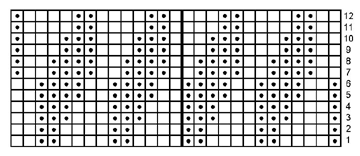
To read that chart for circular knitting you read every row from right to left, as indicated by the row numbers. The blanks are knit stitches and the dots are purls stitches on every round. To convert it to flat knitting you simply alternate which end of the row you start on and read the knit stitches (the blanks) as purls and the purls (the dots) as knit stitches on the WS rows only. Then, to easily pick up the gusset stitches you will want to slip the first stitch of each row, so the flat chart should look as follows:
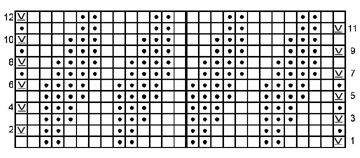
The underlined v (v) indicates a stitch slipped purlwise. In both of these charts the heavier vertical line separates the first and last stitches of a round in the leg. So on the foundation row of the heel you only work the left half of the chart. The directions written out long hand for the heel would be as follows:
Row 1 (RS): *k4, p2; repeat from * for a total of 14 sts the first ending with k2. For any additional repeats of this row, sl1 then begin the pattern from the * and work across all heel stitches, again ending with k2.
Row 2 (WS): sl1, p1, *k2, p4; repeat from * for a total of 27 sts, ending with k1.
Row 3: sl1, *k3, p3; repeat from * to end of heel sts, ending with k2.
Row 4: sl1, p1, *k3, p3; repeat from * to end of heel sts, ending with k1.
Row 5: sl1, *k2, p4; repeat from *, ending with k2.
Row 6: sl1, p1, *k4, p2; repeat from *, ending with k1.
Row 7; sl1, k1, *p4, k2; repeat from *, ending with p1.
Row 8: sl1, *p2, k2; repeat from *, ending with p2.
Row 9: sl1, k1, *p3, k2; repeat from *, ending with p1.
Row 10: sl1, *p3, k3; repeat from *, ending with p2.
Row 11: sl1, k1, *p2, k4; repeat from *, ending with p1.
Row 12: sl1, *p4, k2; repeat from *, ending with p2.
Repeat rows 1-12 until you have 13 or 14 chain stitches on each side of the heel flap or until it is your desired length. Then turn your heel as required for 27 heel stitches and pick up the gusset stitches and continue the pattern as written.
If you are comfortable with how twisted stitches, cables and crossed stitches work you should also be able to use this technique to continue patterns such as those into your heel flap. In general, if you can, keep all unusual stitches (non knit or purl stitches) on the right side rows if possible; especially for crossed or cabled stitches this will make your work easier. Twisted stitches should always be twisted whether on the right or wrong side of the fabric and decreases or increases should always slant the same direction on the right side of the fabric.
Even if the sock pattern uses a different heel, if it is knit from the top down you should be able to easily substitute a heel flap and gusset in order to convert it to clog socks. If you are an experienced sock knitter you will often be able to convert toe-up patterns to top down and add the heel flap so those can be made as clog socks as well.
I do not recommend trying this conversion on your first pair of socks. A certain comfort level with the general construction of socks and experience with charts and more complex stitch patterns will make this process much easier. You might also make your first pair of clog socks from a pattern written for clog socks so that you can familiarize yourself with the process. There are clog sock patterns readily available in knitting publications or for order on the Internet.
For a book, check out Anna Zilboorg’s Socks for Sandals and Clogs (2nd ed ISBN 0976106418)
Some individual clog sock patterns:
- DK’s Flatiron Clog Socks
- DK’s Dimple Socks
- Dawn Brocco’s Cabled Clog Socks
- Salsa Sox
- Persephone’s Dream Clog Socks