Herringbone Rib Socks And Their Inspiration
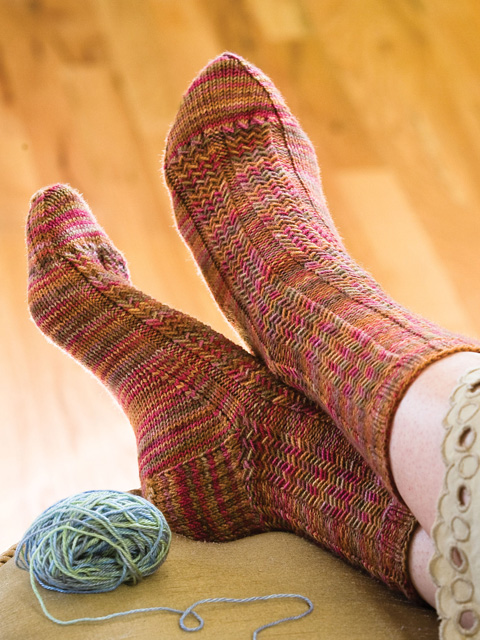
I know many of you have seen the Herringbone Rib Socks from Knitting Socks with Handpainted Yarn already as it was excerpted in the most recent issue of Interweave Knits. Thanks to those of you who recognized my name and sent congratulations already! After nearly a year since I sent off my three pattern proposals the book is officially out! It was in stock at Amazon last Thursday and should be popping up in LYSs and bookstores any day now.
In celebration of the release I thought I’d share a bit of insight into my inspiration for my three patterns that are in the book and my thoughts on yarns that would suit them this week. Keep in mind, I’m not a professional dyer like Carol, the book’s author, and I haven’t seen the book yet so I don’t know exactly what Carol has said about the yarns that suit the patterns. These are just my take on the patterns when I came up with the idea and proposed them to Carol and the books staff at Interweave.
Having come to knitting and spinning via mixed media and paper arts, texture and color are major inspirations to me. I love that knitting can evoke so many different textures and even emulate other types of fabrics.
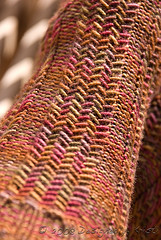 I adore the various stitch patterns that look like woven fabric. Often such stitch patterns manipulate the stitches so much that the fabric looses much of the elasticity that it is recommended the pattern be knit on needles two or more sizes larger than you would normally knit a given yarn with. This of course can be done if you knit the stitch pattern in only the cuff, or if you knit your socks on 2-circs and can use the normal size needle for the sole and the large sized one for the instep and leg. Instead, this stitch pattern uses yarn overs to loosen up this woven-look stitch pattern so it can be knit on regularly sized needles.
My love of color has me unable to resist the wonderfully colorful handpainted yarns out there. I do loath pooling/flashing and certain types of diagonaly striping as well which always makes the handpainted yarns a bit of challenge to actually knit with. So when I was first asked to submit some proposals of projects for this book I bounced around a lot of ideas in my head and made many a swatch. Some of my favorite socks knit with handpainted yarns had stitches manipulated in different directions to mix the colors visually. Combine that with a weave-look stitch pattern and I arrived at the Herringbone Ribs pattern.
My swatch for the proposal used a yarn that had a definite primary color and was then speckled with short burst of other colors. This year I knit a sock with a very manly colorway of Misti Alpaca’s Hand Paint Sock Yarn (12 Shadow) which has a similar color approach as that used in my proposal swatch. In fact, I have a skein of that yarn in a different colorway earmarked in my stash for my own pair of Herringbone Rib Socks :-)
The Claudia’s Handpaint that was used in the book worked well. It is a lower value contrast colorway so it produced an overall sock that looked almost semi-solid even though the yarn actually has several distinct colors in it. When it comes to this stitch pattern I think you can hardly go wrong. Even if the colors stripe diagonally, the fact that you are pulling a stitch from a previous round over stitches in the current round helps to smudge and soften those lines. I am itching to swatch it up in a yarn with many colors (8 or more) in very short bursts - something like some of the Koigu colorways perhaps?
There are already many pictures popping up on Ravelry of these socks in progress knit with many different brands of handpainted yarns. There are even a speed demon or two who are done already. It is a blast to see what everyone is using. Go check it out!
Special thanks goes out to Kristi Geraci, 1/2 of the Knitter’s Anonymous blog who knit these socks for the book. There was no way I could knit so many socks and get patterns written up in the time allotted from project acceptance to due date without some help. She posted about her experience on her blog just before Thanksgiving.