Color Series IV: Contrasts and Perception
Three weeks ago we covered the last of the color descriptors. If you missed the two color descriptor installments or think you may need a refresher, please check them out before continuing. We all need to be on the same page on how to describe colors so we can better discuss color combinations. Today we’ll look at the different ways colors can contrast.
Contrast
Contrast is often defined as “the state of being strikingly different from something else.” Now, if I told you that the color palette you chose for your fair isle sweater was nice, but lacked contrast what would be your first instinct to fix it? Chances are you would choose a darker version of the darkest color or a lighter version of the lightest color or both. When people discuss contrast with no further qualifiers it is most often in reference to value. That is one of the strongest forms of contrast since that is the characteristic of a color that we can perceive from the greatest distance. However, that is only one of many ways colors can contrast with each other. A richer or more dynamic color palette can be created by incorporating other forms of contrast in a color scheme.
Contrast in Saturation and by Default Value
Thinking back to the previous installment, saturation is a measure of the pureness of a hue. When we tint or tone a color we are changing its saturation and value. So, a contrast in saturation is also a contrast in value. This is one of the easier contrasts for us to evaluate because our visual experience is dominated by value.
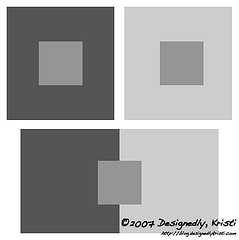 When we explore three colors that are identical in all areas except saturation we find an interesting shift takes place. If you take the middle saturation color and place it in the center of a light and dark saturation you see the middle one looks like two different colors. In the image at left we see the effect on a neutral gray, removing the complications of hue it is a look at just value contrast. The smaller middle square is the same in both larger squares, but the one in the darker large square appears lighter than the one in the lighter large square. On the bottom of the graphic, you can see the middle gray is indeed the same shade, no matter what your eyes and brain tell you.
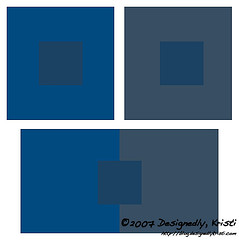 In this image (right) you can see it also happens when hues are involved. If you vary the tonal family in the example you end up introducing other forms of contrast, hence this simplistic demonstration. You should experience a similar effect as you did with the gray boxes.
Contrast of Hue
The highest contrast of hues is formed by complimentary colors. If you recall, the complimentary colors are directly opposite on the color wheel. Some examples include blue and orange, green and red, violet and yellow etc. If you don’t have a color wheel handy an easy way to determine the complimentary color is to stare at the color for at least 20 seconds and then look at a white area. Because of the way the light interacts with the rods and cones in our eyes you see what is called an after effect on the white that happens to be the opposite color. Give it a try!
While complementary colors add a lot of energy to an object, when you place equal amounts of complimentary colors which are of the same saturation and tone etc. next to each other there can often be an unsettling feeling. This can often be used effectively in visual art to help convey the feeling of the piece, however in usable/wearable fiber arts I suspect that is not often a desired outcome. In the image below, look at the left side of the central boxes and notice how that line between the orange and blue kind of vibrates?
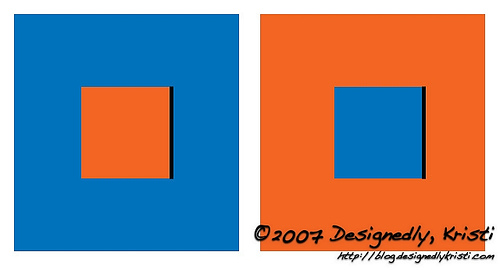
This effect can be reduced in a variety of ways. The easiest way to reduce the uneasiness is to use unequal proportions of the complementary colors. Contrasting the two colors in other areas as well by choosing different saturations for example can also be quite effective; think of the pink and green color combo that has been popular. If the complimentary colors are broken up with a neutral like black, brown, or white, the energy of the complementary colors combo remains, but is more pleasant to an observer. See how the vibration is greatly reduce when you look at the right side of the central boxes above?
The complementary colors can also serve to help your design pop. If you are working an intarsia design and the background color and the design color are not contrasting enough, you can make the intarsia stand out better by outlining that section with its complementary color.
Contrast in Chromaticity
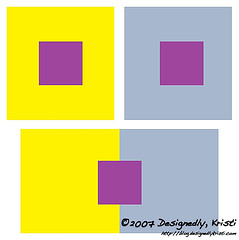 Just as we saw with contrast in saturation, when surrounded by another chromaticity, the perceived color characteristics can be tilted towards the opposite of those in the surrounding color. For example, a bright vibrant color around a medium chromaticity color will make that medium color appear duller (left). The opposite is also true. If a dull, low chromaticity color surrounds a medium one, that medium one will appear more vibrant than when viewed alone (right). Again, if you need to, use a white sheet of paper to cover half of the graphic.
Contrast in Temperature
You may have at this point noticed a trend in the contrasts. The surrounding color enhances the opposite trait(s) of the color it surrounds. A darker color makes a lighter color appear even lighter than it does on it’s own. A duller color makes a brighter color appear even brighter. The same holds true with contrasts in color temperature or undertones. This is most notable when the middle color is one on the line between warm and cool colors.
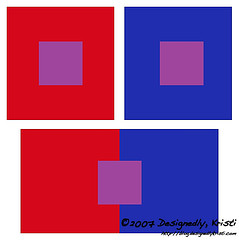 In the graphics at right, notice how the red-violet appears cooler when surrounded by the warmer red and appears warmer when surrounded by the cooler blue. This form of contrast is also sometimes referred to as simultaneous contrast, depending upon your source for color theory information.
Conclusion
When working with yarn we don’t have the luxury of an unlimited color palette unless we are dyeing our own, so often we’re not going to be able to work with only one of these forms of color contrast. That is okay. It is just important to be aware of the different ways in which a color can contrast with those around it so you can better evaluate what you like or dislike about a given color combination. You can also use these perceptions to adjust how a color in your design is perceived.