The feats and foibles of a fiber fanatic.
4/24/2006
It seems everyone got the picture right, so I used the random number generator to pick a number and the lucky number was 10, which corresponded to Hillary‘s comment. So, Hillary, either leave a comment here or drop me an e-mail with the name of the pattern you would like and I’ll e-mail it out to you. Congrats and happy knitting!
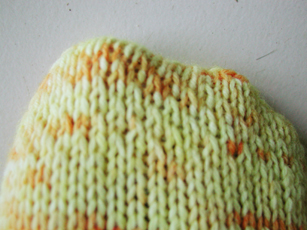
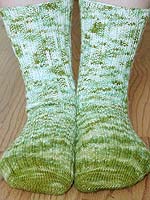
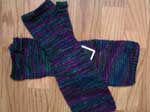
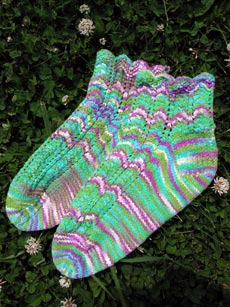
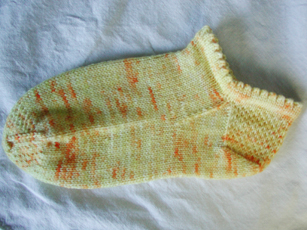
This is just anklet number one. I completed it on Tuesday or Wednesday last week. It has a picot edge and an eye of partridge heel and toe! The yarn is some I dyed with Kool-Aid at the very end of March in preparation for Project Spectrum. It was a half hank of the KnitPicks Dye Your Own with 6 packets of lemonade. When that bath was exhausted I sprinkled 3/4 of a packet of orange over the hank in different places. I would rearrange the hank occassionally during the sprinkling to try get as equally distributed amount of orange on the hank as you can get when you are randomly sprinkling. If I remember correctly I think put the hank in my dyeing mesh collander over the same hot bath that was exhausted of the lemonade and turned up the heat a bit to steam set the orange.
This anklet was my SnB and a bit of TV watching knitting down at the very end of Seraphim when I was into the lace section that required a little less divided attention. I think it makes a fun spring sock. Too bad I don’t have the other one done as we’re having one of our spring storms today. It is super gray and actually snowing out (though none appears to be sticking at this point). It would be fun to have these socks to brighten the day today.
4/4/2006
Lolly has chosen some wonderfully appropriately springy colors for April’s Project Spectrum - Yellow and Orange! And really, even those in the southern hemisphere should do okay with the orange in autumn as well.
In honor of Project Spectrum yesterday I made myself a Project Spectrum lunch and also captured a few other foods in the kitchen that were Orange and Yellow…
1. April PS Lunch in the Making, 2. April PS Lunch, 3. April PS Peppers, 4. April PS in the Pantry
This weekend I also did some dyeing. Again with Wilton’s and a touch of Kool Aid as well.
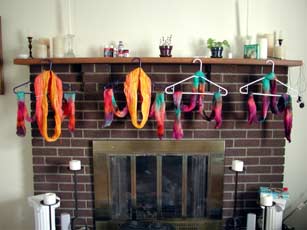
This is what our fireplace/hearth looked like on Saturday morning, LOL! It looks kind of like Christmas, but with whacked out colors!
I did some Project Spectrum sock yarn dyeing using a similar method of dyeing as I used in the Bayou yarn, but this time I double dyed it - once in rose (tweaked a touch with some green to tone it down every so slightly) and then the balls rewound the other direction and dyed again in lemon yellow in a *very* strong solution.
I also did some fiber dyeing for the first time. I’ve been so paranoid that I would felt it that I hadn’t tried it. But after being afraid of felting fleece when washing it and being successful in that I decided I could dye fiber without felting it. Both sets of colorways are dyed with the same four dyes that I mixed based on the colors of my Not-So Squatty Sidekick. The differences in them are just in the percentages used of the different colors. Isn’t that amazing?
1. Snow Cone Roving Pre Drafted and Not, 2. Snow Cone Roving, 3. A Comparison of Northern Lights Roving Pre Drafted and Not, 4. Northern Lights Roving
I also took the opportunity to put together a few Project Spectrum Desktop Wallpapers for the month of April seeing as how the March one went over so well and Scout informed me I should do so for each month of Project Spectrum… So, if you click on these just hit “All Sizes” right above it and choose the size appropriate to your computer desktop and right click to set as wallpaper in most browsers. I hope you enjoy!
3/22/2006
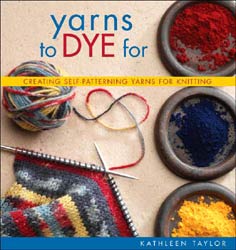
As mentioned last week, Snow kindly gave me a copy of this book (along with many skeins of KnitPicks Color Your Own fingering weight yarn). I promptly finished reading the book and have since been ruminating on it and rereading sections and perusing the projects so I can give a thorough review of the book here for those who requested one.
To start with the basics, Yarns to Dye For by Kathleen Taylor (yes the same one who has designed many patterns for KnitPicks) is published by Interweave Knits. It is a relatively small volume of about 100 pages split into two main sections - an introductory how-to entitled principles and a projects section.
The “Principles” section coves the usual information such as tools and supplies needed as well as the various basic techniques that will need to be applied in the project section. It is roughly 1/3 of the book in length. Taylor shares her experiences in dyeing by recommending certain dyes and the pros and cons of those dyes, her recommended skein length, as well as her basic techniques for large graduated color bands, what she calls zig-zag yarn (non-striping varigation), faux fair isle, and self-striping yarns. She also has a small section on immersion dyeing in case you want to dye some solid color yarn to match your multi-color creations. The section on heat setting yarn includes both stove top steamer and microwave techniques. She does caution that one should probably use a microwave no longer used for food if going that route.
Once you have the basics down it is onto the project section which takes up about 2/3 of the book. There is a chapter on each type of hand painted yarn - graduated color bands, zig-zag, fair isle, and striping. Within each chapter are projects including the dye and painting recipes as well as the knitting pattern. Each chapter has between three and ten projects in it, many of those projects are geared and sized towards children, but there are also some adult-sized projects and a home decor project in there. In general, the projects are pretty basic and could be put together on your own if you are an experienced knitter, they include things such as hats, mittens, scarves, gloves, fingerless gloves, socks, tank tops, throw pillows etc. However, if you are shy about your color skills the recipes in there for painting the yarn could be really useful.
For me, the best part of the book was the first section (though I was already familiar with a lot of the information provided there) and the painting recipes in the project section to see what sort of lengths were being painted to achieve the different looks. I personally will probably not be dye and knit any of the projects in the book, but then I rarely knit a pattern as directed anyway (I knit how I cook - recipes and patterns are guides from which to start but then I add in my own flavors). Well, I might find myself knitting a pair of watermelon socks, but that is probably the only project in there that stands a chance of my knitting it. The finished projects do stimulate some ideas and remind me of other dyeing options.
While I thought for the most part the first section of the book was pretty thorough I felt Taylor was missing one huge puzzle piece. Here she was calling for a ginormous skein circumference and she instructs one to have pegs screwed into a wall at 1/2 that circumference. I don’t want to give away her information, but let’s just say we are not talking pegs that are just a few paces from each other, we’re talking many, many yards apart. Not only do I not really have any space long enough for stretching out such huge skeins, but I don’t have the stamina to walk a 440-yd or 880-yd skein around pegs that far apart.
Earlier this week in an itch to dye some April Project Spectrum sock yarn I decided my best bet was to wrap my yarn around the railing to our basement stairs. Well, it only took about ten trips up and down before I realized what a stupid idea that was. I decided I’d just take the ball with me whenever I went up or down the stairs. Only I discovered most of the time my hands are full with something - laundry, dog toys, glass of water, plate of food, etc.
No matter what you do, re-skeining to a large skein size is going to be a bit tedious. But it doesn’t have to be physically exhasting as well. I mentioned my railing tactic at SnB on Monday evening and a couple people mentioned warping boards. I knew of their existence, but didn’t know what they looked like or how they were used. So I sat down and had some nice quality time with Google yesterday…
For those of you unfamiliar with what a warping board is, it is traditionally a frame with some pegs on it and by wraping the pegs in a certain fashion you can achieve different lengths of yarn. Weavers use the warping board to prepare their warp. When wrapping the board they put a twist in the wraps so that the order of the yarn stays in order making it easier to transfer the warp to the loom. Now, a warping board can also be used to create a long skein length, you just need to wrap it such that you don’t have a twist in each pass.
There are many warping boards on the market. There is one made specifically for striping sock yarn by Forsyth. I could not find any information on what length of a skein it makes, though it does come will full instructions. I suspect it is a much smaller skein that what Taylor calls for in her book and the larger skein you can make the longer your repeat. When you get to a size that can handle 20+ yard lengths they start getting expensive. I’ve also been told that those sort of lengths can be tough on the arms and shoulders. In which case a warping mill or reel may be a better solution both physically and time-wise but they are even more expensive.
There are a couple places on-line that describe making your own warping board…
- In the Wood Shop
- What Housework?
I was not successful finding info on-line about building your own warping reel, though I suspect there must be something out there about building your own yarn blocker and there should only be a slight modification from that to a warping reel I would think. There are supposedly plans in Spinning and Weaving with Wool by Paula Simmons if you can get your hands on a copy.
I’d say Yarns to Dye For is a great place to start learning how to dye yarns that will stripe or specifically not stripe. This is especially so if you are not comfortable with color theory or designing your own knitting patterns. If you are comfortable with both of those you might be better off checking it out from your local library or through ILL. I do suspect I’ll still pull this one off the shelves regularly for some inspiration. I do think Taylor has done a bit of disservice to her readers by failing to mention another option for creating the large skeins called for in the projects. Obviously I’m not ready to go out and drop $100-$400 on a warping board/reel/mill right now so it is nice to know there are options that do not cost me additional money, but it would also be nice to know of tools that would make the process easier.
2/15/2006
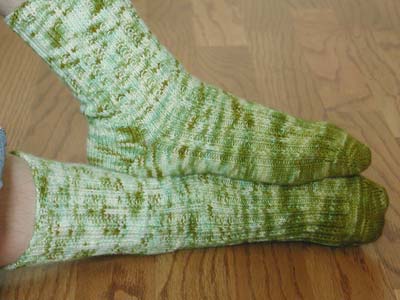
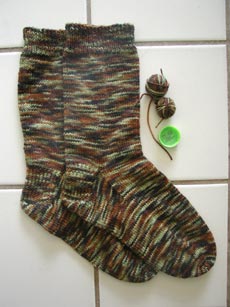
Pattern: DK Swamp Socks (to be available soon), 64 Sts
Yarn: 1 Skein Knit Picks Color Your Own, in DK Bayou colorway, 440 yds Fingering Weight 100% Merino
Needles: 2 16-inch Addi Turbos in US 1 (2.5 mm)
Gauge: 8.5 sts/inch in st st
Recipient: Myself, because I’m greedy!
Process Dates: January 30th - February 13th, 2006
Notes: This pair of socks was an entirely new experience for me. I knit them on 2 circulars from the toe up. That meant learning a new cast-on (or two, I tried the provisional cast-on with a short row toe and then opted for the Turkish cast-on), making short row heels, and learning a new bind off technique (sewn bind-off). That said, this was one of the fastest pair of sock-weight socks I’ve knit despite two major frogging sessions between the pair (one session per sock). The gauge is a bit looser than I tend to usually use so I was using a smaller number of sts than my previous sock-weight socks so I’m not quite ready to conceed that socks soar on two circulars. Though I did like 2-circs much, much better than magic loop and may end up being a convert. We’ll see how I feel using them for top down varieties…
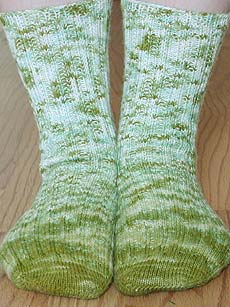
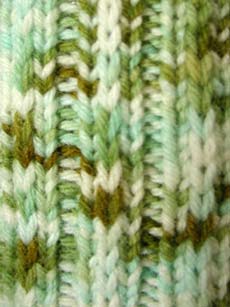
I wore the socks all day yesterday and have had no problems of the sock twisting on my foot like I feared would happen with the short-row heels. I did do one more set of wraps on the second heel to narrow it a bit and that did help get rid of the “ears” my heel had with the first sock. But I’m still not sure I’m a fan of the short row heels. I really don’t like that the sides of the heel don’t match (I know, how very knit picky of me) and despite picking up extra stiches at the rejoin with the rest of the stiches I had holes to patch upon completion. The short row heel will be the major deterent for my knitting more socks tow-up. I won’t say I’ll never do it that way, but I’ll probably think pretty hard before choosing to do that again despite my success with the Turkish cast-on and the reverse wedge toe. I do have some yarn from DH that I’ll do toe up so he gets the maximum leg length possible as I know that he likes long legs on his socks and I’d rather not play a guessing game.
12/14/2005
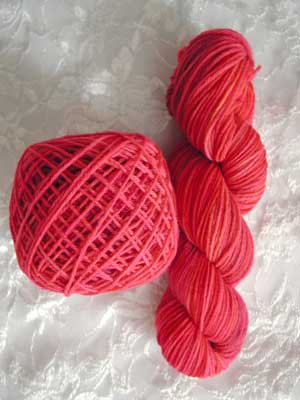
*Finally* I can share this dyeing experiment that took place during dyeing week in late November…
This yarn was dyed for fellow SnB gal, Amanda. Her birthday is on Friday, so I brought this yarn to her on Monday night at SnB. It is also dyed with Wilton food coloring like the other yarns I dyed that week, but this one got a special treatment as well that will result in 8 or 9 *matching* stripes per sock, so kind of thick stripes.
How did I do this you ask? Well, let me tell you…
I used one skein of KnitPicks Color Your Own Sock Yarn and the 4 main red/pink colors of Wilton’s food coloring. You can use any colors you want, though I suggest when you start to use analogous colors (colors that appear next to each other on the color wheel) or different shades of the same color family because it isn’t an exact science and some bleeding of colors can occur, especially the first time you try it.
1. Take the hank of yarn and wind it into a center pull ball.
2. Take the center pull ball and with both ends together, wind it into a doubled center pull ball. Clip the loop so you now have the skein split in half.
3. With your swift at it’s widest (~2 yd circumference), wind the double yarn onto the swift between 10 and 15 rotations. I tie a little bit of scrap to one support of the swift so I can more easily count the rotations. Then, tie this round of yarn in 4-5 spots. It may seem excessive, but it is *very* helpful to the process. Just be sure the ties are loose enough that the dye will still penetrate the yarn.
4. Repeat step 3 until all the yarn is used, tying the most recent group of rotations together and making sure not to get any other rotations tied in with it by accident. This will result in roughly 20-30 yd lengths of yarn for each skein of sock yarn in each section.
5. When all the yarn is hanked and tied into these mini 20-30 yd hanks, figure eight tie very loosely all the groups together with one large tie.
6. Soak yarn for a couple of hours in a strong vinegar/water solution.
7. Prepare your dyes to the strength you desire and put in large squirt bottles (I used ketchup bottles from the dollar store). Since I was using food coloring I mixed it with a strong vinegar/water solution.
8. Prep your dying space with protective newspapers and such, then lay down a run of plastic wrap long enough to easily incase the length of your hank.
9. Lay down the first mini-hanked section, apply the desired dye, wrap in saran wrap and move slightly to the side.
10. Lay down another sheet of plastic wrap and repeat step 9. Repeat this until the entire hank of yarn has been dyed.
11. I had a few sections that weren’t as well contained in their plastic wrap so I then wrapped the whole darn thing in plastic wrap again.
12. Place in a wire mesh strainer (dedicated to dyeing) over boiling water and steam for at least 45 minutes. If you are using a hard to set color like red, you might consider steaming for up to 2 hours. Be sure to flip your wrapped up yarn over a couple of times during the steaming process to ensure that all areas get plenty of direct steam heat.
13. Let cool before rinsing. This can aid in exhausting the dye in some cases.
14. Rinse.
15. Let dry.
16. Now, you need to reskein it into two separate skeins. It’s a piddly process because in winding the doubled center pull ball and putting it on the swift, the two strand of yarn have twisted around each other. So, I recommend making two center pull balls by hand as you pull the yarn off the swift. This way you can easily untwist the two strand of yarn as needed easily. I used two poor man’s nostepinnes (empty toilet paper tube and an empty paper towel tube) in this case. You can hook one strand up to a ball winder, but I personally found it easier to just have the two handmade balls in my lap.
17. You may keep them in these center pull balls. If you used a ball winder or nostepinne there shouldn’t be any problem with storing them long term in the ball form. If you did not have the open space for the ball to expand into you may loose elasticity in your yarn and you should then use your swift to put it into skeins again for storage. You might want to flag the matching ends of each skein if it isn’t obvious which ends match.
Now, with the red, I of course had trouble with the color setting, but I had steamed for a solid two hours. So, I unwrapped it and put it into the water and set it further in simmering water. This caused some bleeding of the different reds together, so the striping is subtle, but more noticeable than I thought when I first removed it from its bath. Also, because I tried rinsing for a while before putting it in for another bath it made the sock much more pink than I was originally intending, but I actually quite like it.
I decided to name it strawberry trifle because I figure the thicker stripes in the socks will look like the layers of a trifle and I thought the color was quite reminiscent of strawberry flavored things (like DH’s liqueur etc.).
When I was making the center pull balls of this yarn the one on the paper towel tube worked out much better for me (look at it, it’s the one still in a ball up there). I think that was because I have more room to hold onto so the movements could be smoother, which then resulted in a much more uniform ball of yarn. It makes me want a nostepinne or two :-)
I’ll try talk Amanda into letting me blog the completed socks whenever she decides to knit them up so you can see the truly final result of this dyeing experiment.