Yarns to Dye For
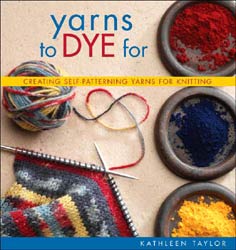
As mentioned last week, Snow kindly gave me a copy of this book (along with many skeins of KnitPicks Color Your Own fingering weight yarn). I promptly finished reading the book and have since been ruminating on it and rereading sections and perusing the projects so I can give a thorough review of the book here for those who requested one.
To start with the basics, Yarns to Dye For by Kathleen Taylor (yes the same one who has designed many patterns for KnitPicks) is published by Interweave Knits. It is a relatively small volume of about 100 pages split into two main sections - an introductory how-to entitled principles and a projects section.
The “Principles” section coves the usual information such as tools and supplies needed as well as the various basic techniques that will need to be applied in the project section. It is roughly 1/3 of the book in length. Taylor shares her experiences in dyeing by recommending certain dyes and the pros and cons of those dyes, her recommended skein length, as well as her basic techniques for large graduated color bands, what she calls zig-zag yarn (non-striping varigation), faux fair isle, and self-striping yarns. She also has a small section on immersion dyeing in case you want to dye some solid color yarn to match your multi-color creations. The section on heat setting yarn includes both stove top steamer and microwave techniques. She does caution that one should probably use a microwave no longer used for food if going that route.
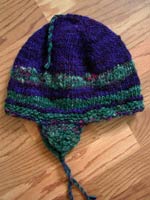
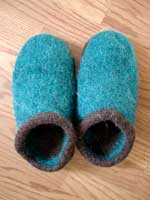
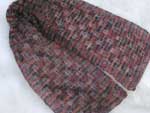
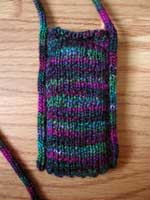
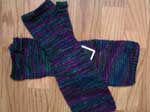
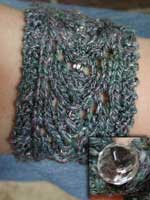
Once you have the basics down it is onto the project section which takes up about 2/3 of the book. There is a chapter on each type of hand painted yarn - graduated color bands, zig-zag, fair isle, and striping. Within each chapter are projects including the dye and painting recipes as well as the knitting pattern. Each chapter has between three and ten projects in it, many of those projects are geared and sized towards children, but there are also some adult-sized projects and a home decor project in there. In general, the projects are pretty basic and could be put together on your own if you are an experienced knitter, they include things such as hats, mittens, scarves, gloves, fingerless gloves, socks, tank tops, throw pillows etc. However, if you are shy about your color skills the recipes in there for painting the yarn could be really useful.
For me, the best part of the book was the first section (though I was already familiar with a lot of the information provided there) and the painting recipes in the project section to see what sort of lengths were being painted to achieve the different looks. I personally will probably not be dye and knit any of the projects in the book, but then I rarely knit a pattern as directed anyway (I knit how I cook - recipes and patterns are guides from which to start but then I add in my own flavors). Well, I might find myself knitting a pair of watermelon socks, but that is probably the only project in there that stands a chance of my knitting it. The finished projects do stimulate some ideas and remind me of other dyeing options.
While I thought for the most part the first section of the book was pretty thorough I felt Taylor was missing one huge puzzle piece. Here she was calling for a ginormous skein circumference and she instructs one to have pegs screwed into a wall at 1/2 that circumference. I don’t want to give away her information, but let’s just say we are not talking pegs that are just a few paces from each other, we’re talking many, many yards apart. Not only do I not really have any space long enough for stretching out such huge skeins, but I don’t have the stamina to walk a 440-yd or 880-yd skein around pegs that far apart.
Earlier this week in an itch to dye some April Project Spectrum sock yarn I decided my best bet was to wrap my yarn around the railing to our basement stairs. Well, it only took about ten trips up and down before I realized what a stupid idea that was. I decided I’d just take the ball with me whenever I went up or down the stairs. Only I discovered most of the time my hands are full with something - laundry, dog toys, glass of water, plate of food, etc.
No matter what you do, re-skeining to a large skein size is going to be a bit tedious. But it doesn’t have to be physically exhasting as well. I mentioned my railing tactic at SnB on Monday evening and a couple people mentioned warping boards. I knew of their existence, but didn’t know what they looked like or how they were used. So I sat down and had some nice quality time with Google yesterday…
For those of you unfamiliar with what a warping board is, it is traditionally a frame with some pegs on it and by wraping the pegs in a certain fashion you can achieve different lengths of yarn. Weavers use the warping board to prepare their warp. When wrapping the board they put a twist in the wraps so that the order of the yarn stays in order making it easier to transfer the warp to the loom. Now, a warping board can also be used to create a long skein length, you just need to wrap it such that you don’t have a twist in each pass.
There are many warping boards on the market. There is one made specifically for striping sock yarn by Forsyth. I could not find any information on what length of a skein it makes, though it does come will full instructions. I suspect it is a much smaller skein that what Taylor calls for in her book and the larger skein you can make the longer your repeat. When you get to a size that can handle 20+ yard lengths they start getting expensive. I’ve also been told that those sort of lengths can be tough on the arms and shoulders. In which case a warping mill or reel may be a better solution both physically and time-wise but they are even more expensive.
There are a couple places on-line that describe making your own warping board…
- In the Wood Shop
- What Housework?
I was not successful finding info on-line about building your own warping reel, though I suspect there must be something out there about building your own yarn blocker and there should only be a slight modification from that to a warping reel I would think. There are supposedly plans in Spinning and Weaving with Wool by Paula Simmons if you can get your hands on a copy.
I’d say Yarns to Dye For is a great place to start learning how to dye yarns that will stripe or specifically not stripe. This is especially so if you are not comfortable with color theory or designing your own knitting patterns. If you are comfortable with both of those you might be better off checking it out from your local library or through ILL. I do suspect I’ll still pull this one off the shelves regularly for some inspiration. I do think Taylor has done a bit of disservice to her readers by failing to mention another option for creating the large skeins called for in the projects. Obviously I’m not ready to go out and drop $100-$400 on a warping board/reel/mill right now so it is nice to know there are options that do not cost me additional money, but it would also be nice to know of tools that would make the process easier.