4/7/2006
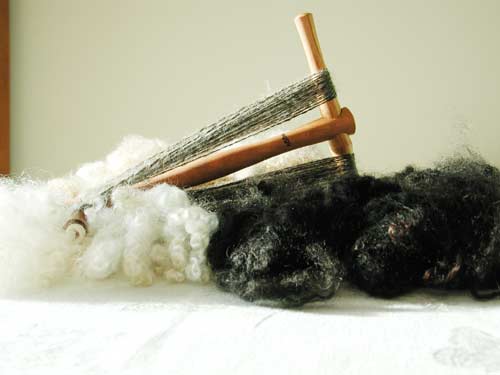
When Liz and I went to Black Pines Sheep we got to see the shed where Myrtle skirts the fleeces. We got to pet many unwashed ones. Then, Myrtle allowed us to have a handful of fleece from four different ones. I’ve since spun up two of those samples…
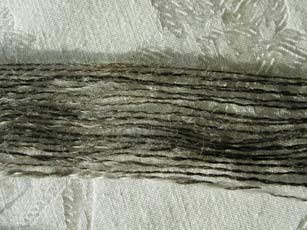
For the Wensleydale/Lincoln cross the fleece was washed, dried and then teased by hand before spinning from the lock on a CD drop spindle. I got 18-yds from the 4gm sample. This was my absolute favorite in the lock form. It looked like curly tarnished silver. It has really good luster which I don’t think I’ve managed to quite capture digitally.
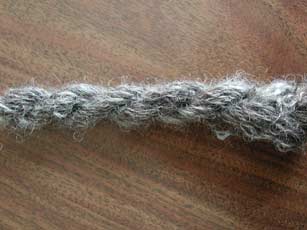
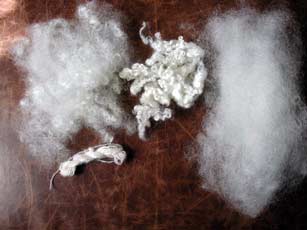
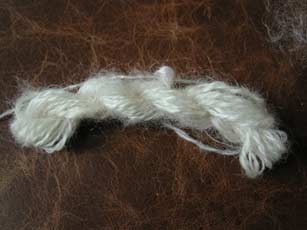
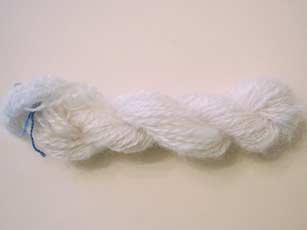
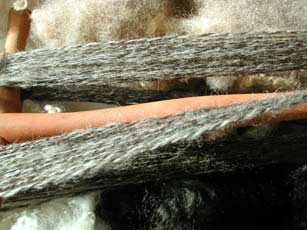
Here is the Teeswater. In the first picture you can see from left to right the flick carded locks, the original washed locks, and the handcarded rolags. The tiny skein (4 yd, unmeasureable on my postal scale in terms of weight) in that photo was spun from the flick carded locks on a drop spindle. I found it awfully slippery to have much luck from the locks on this one, though I’m thinking it could be easier to accomplish using the wheel. So, I turned to hand cards I’ve had on a seriously long loan from Snow. It carded quite nicely even though the staple length was about 5-5.5 inches (I didn’t actually measure) and I later read handcards are best for staple lengths of 3 inches or less. I found it much easier to spin on the drop spindle from the rolag in the case of the Teesewater. The third photo is a 28-yd skein spun on a drop spindle from the rolag. I also *really* like the overall appearance of this one, as it is soo shiny you’d swear there was a good percentage of silk in there though once again the digital realm doesn’t really do it justice.
Both of these are quite hairy yarns, I think due to the way I processed and spun them. They both still have a lot of luster. Howver, the Wenselydale/Lincoln cross as a really nice, soft hand. The Teeswater isn’t quite as soft. It isn’t harsh, but some wouldn’t want it next to the skin. However, I think combed Teesewater would be *heavenly*! And, Lizzy B told me that Teeswater takes dye exceptionally well!
I think I can say without a doubt that some of both of these types of fleeces will enter my home at some point. The real question is when? :-)
4/6/2006
As you all so wisely knew long before I did, when Liz and I went out to Black Pines Sheep I of course came home with some fleece. I was reserved though since I do not have a drum carder or combs or even so much as a proper flicker. I bought a 1/2 CVM/Romeldale fleece of about 3 pounds. So, on our way home from lunch and the IWP tour we stopped off at Bed, Bath and Beyond to purchase a salad spinner and some mesh laundry bags. Then Liz gave me a lesson in washing fleeces. Since Myrtle was very generous I got instructed on the differences in washing between Wensleydale and Teeswater versus the CVM/Romeldale. Below are some photos and instructions on how Liz taught me to wash fleece.
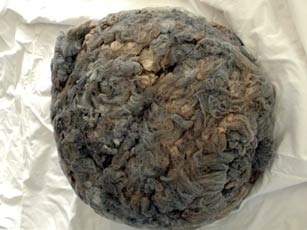
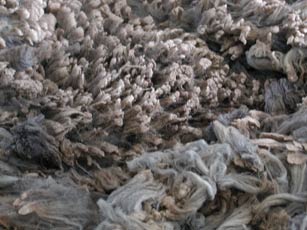
First, take the fleece out of the packaging and roll it out flat to double check the skirting and seperate the fleece into batches of similar characteristics if it isn’t uniform. Similar staple lengths and crimp should be together of if you want to sepeate colors. We did this on the kitchen floor on an old bed sheet. It worked quite well.
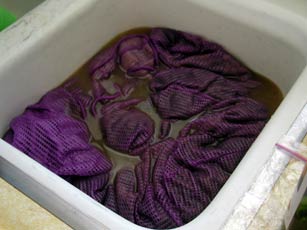
Take roughly 1-lb of fleece (or 1/3 the size of your mesh laundry bag) put it into your mesh laundry bag and close. Then run one side of your sink full of the hottest water you can get. Place the bag into hot water while filling the other side of the sink with equally hot water. Gently press down until the wool all sinks to the bottom and is all wet. There is no need for soap here yet you are just removing the dust and dirt. Don’t leave it to soak too long or all the dirt will resettle onto the fleece, so pull out by the top of the bag not really getting in contact with the wool and drain the sink. Remove fairly quickly after about 1-2 minutes. Let gravity drain most of the water off and then gently use the pressure of the bag to push a bit more of the dirty water out. Because I have some after effects of a car accident and am a bit weak I’ll often use the side of the sink to help me remove so the water. Place the bag agains the edge and with one hand gently apply pressure straight to the wool. You don’t want to agitate as the hot water has opened the scales on the wool and could cause it to felt. But, don’t be scared of the wool either.
Repeat in the other side of the sink and continue until the water is mostly clear. You may wish to change the orientation of the bag in the water to expose other parts of the fleece to the water.
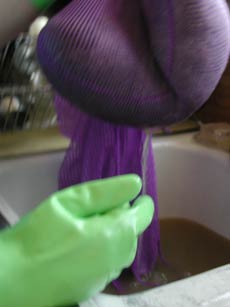
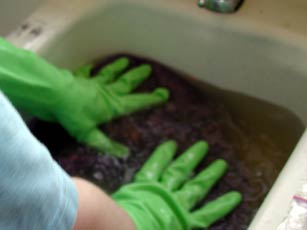
Once the rinse water is semi-clean and definitely no longer opaque add some mild detergent to the next sink of water. Liz recommends Era Plus. We used Palmolive dish soap because it doesn’t have drying agents like many other dish soaps and we could not readily find Era Plus without a chase around town. If using laundry detergent, choose one without extra brightners or chlorine etc. Continue in the same manner, letting it soak in the soapy water for a few minutes, but don’t let the water cool down too much or the grease and the soap will redeposit on it. I’d say we left it soak in the soapy water for about 4-6 minutes. For cleaner fleeces like these usually 2-3 sinks of soapy water will remove the lanolin and any remaining dirt.
Repeat again with clean water to rinse out the soap. Again this will likely take 2-3 sinks.
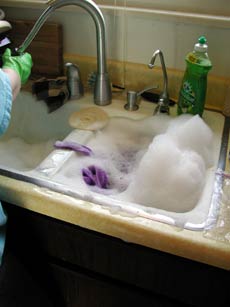
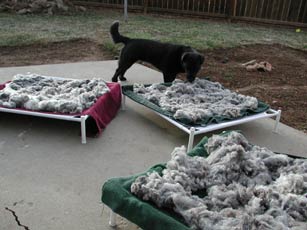
When the sink water is free of soap put the wet fleece in your salad spinner and keep running it until you have no water to tip out of the spinner’s bowl. You would flip the fleece over and reposition it for each round in the salad spinner. This fleece took about 3-4 runs through the salad spinner per bag of fleece washed. Then spread the fleece out on drying racks or a bed sheet. I only lined the sweater racks with towels because DH is a little finicky and I was concerned of his being convinced that the racks forever smelled like sheep.
Repeat all these steps until your fleece is all cleaned.
There are many different ways in which to clean a fleece. I prefer doing small batches in the kitchen sink because it is easier on my back. Also, I can be filling the other half of the sink for the next step while I’m completing each step. But if this doesn’t sound like the method for you, one of these might work better…
* ICanSpin.com
* Fuzzy Galore - has really good scientific reasoning for some of the steps
* The Joy of Handspinning
* Divergent Threads
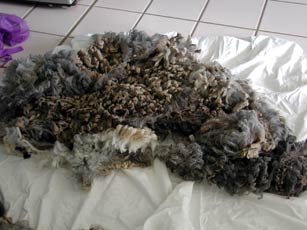
Oh, and one last photo… Check out the difference between the washed (left) and the unwashed fleece…
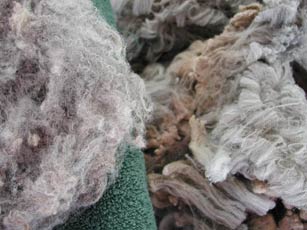
Happy Washing!
3/17/2006
I’ll be back later today with more info about yesterday’s road trip, but I have something like 70 photos to sort through which I’m sure won’t happen in time to get a mid-morning post in like normal.
In the meantime, if you are a spinner, check out the brand spankin’ new blog from Interweave - http://www.soarblog.com/
2/23/2006
After my post about the gorgeous silk hankies from Chasing Rainbow Dyeworks on Tuesday I got some questions about how one spins silk hankies…
Since I suspect I won’t be spinning up the hankies very soon and thus cannot put together my own how-to, I sought out information from the wonerful web. There were a few resources out there. There is a great article on Knitty.com from Amy Singer. She is speaking of spinning the hankies on a drop spindle, but the fiber prep is the same whether you use a spindle or a wheel. She has lots of photos and good descriptions.
Treenway Silks also has a page about spinning from bells and hankies with good information, though it doesn’t contain many photos. Also HJS Studio has a great description with some photos on spinning from caps (the same as bells and the technique is the same whether it is a hankie or a bell). If you are wondering how silk hankies are made I suggest checking out the demonstration on wormspit.com.
Enjoy learning about silk hankies/caps/bells/mawatas!
2/21/2006
and all I got was this gorgeous 3 oz of silk hankies…
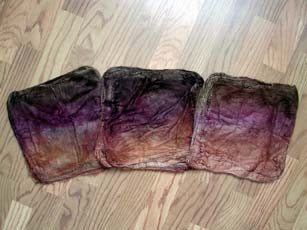
Okay, so truth be told, if I actually went to Stitches West I’d be sure to have bought much more than 3 ounces of silk hankies. However, this was much easier on the budget and the body.
The wonderful (and frequent traveler for work) Amanda brought these back for me from Stitches West upon my request for semi-solid silk hankies from Chasing Rainbows Dyeworks. She did an amazing job of color choice (these are Mendicino Hedges). Enough color difference to make a nice rich and deep yarn, but subtle enough to not be garish or to barber pole too bad when plied etc. I’m so excited to work with these as I loved spinning from a bell in our spinning class with Maggie Casey at Shuttles, Spindles, and Skeins. I’m guessing this will grow up to be a shawl of some sort at some time. But for now I’m perfectly in love with gazing upon the gorgeous things in their hankie state (which is a good thing seeing as how I have 101 things that need doing THIS WEEK).